Thank you for visiting SNEWPapers!
Sign up free
Commercial
July 22, 1889
Telegram Herald
Grand Rapids, Kent County, Michigan
What is this article about?
New York report on July 21 details suspicions that the Sugar Trust, via companies like Havemeyer & Elder, has stockpiled refined sugar in Brooklyn warehouses to engineer a market corner and raise prices. Consumers are also storing sugar in anticipation, while brokers cite low prices and no profit. Speculation links it to countering Claus Spreckels' refinery, but insiders deny enmity.
Clipping
OCR Quality
95%
Excellent
Full Text
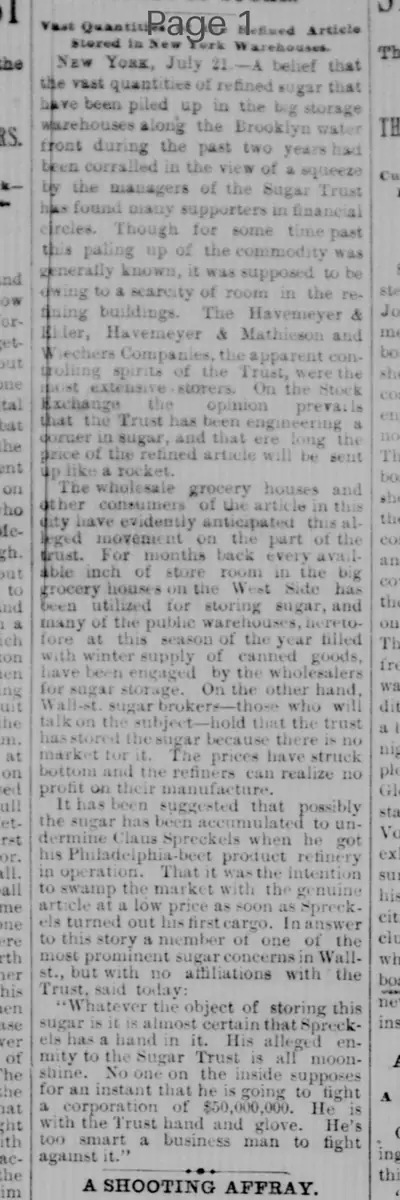
Stored in New York Warehouses.
New York, July 21—A belief that the vast quantity of refined sugar that has been piled up in the big storage warehouses along the Brooklyn water front during the past two years had been corralled in the view of a squeeze by the managers of the Sugar Trust has found many supporters in financial circles. Though for some time past this piling up of the commodity was generally known, it was supposed to be owing to a scarcity of room in the refining buildings.
The Havemeyer & Elder, Havemeyer & Mathieson and Weichers Companies, the apparent controlling spirits of the Trust, were the largest warehouse storers. On the stock exchange the opinion prevails that the Trust has been engineering a corner in sugar, and that ere long the price of the refined article will be sent up like a rocket.
The wholesale grocery houses and other consumers of the article in this city have evidently anticipated this alleged movement on the part of the trust. For months back every available inch of store room in the big grocery houses on the West Side has been utilized for storing sugar, and many of the public warehouses, heretofore at this season of the year filled with winter supply of canned goods, have been engaged by the wholesalers for sugar storage. On the other hand, Wall St. sugar brokers—those who will talk on the subject—hold that the trust has stored the sugar because there is no market for it. The prices have struck bottom and the refiners can realize no profit on their manufacture.
It has been suggested that possibly the sugar has been accumulated to undermine Claus Spreckels when he got his Philadelphia-beet product refinery in operation. That it was the intention to swamp the market with the genuine article at a low price as soon as Spreckels turned out his first cargo. In answer to this story a member of one of the most prominent sugar concerns in Wall St., but with no affiliations with the Trust, said today:
"Whatever the object of storing this sugar is it is almost certain that Spreckels has a hand in it. His alleged enmity to the Sugar Trust is all moonshine. No one on the inside supposes for an instant that he is going to fight a corporation of $50,000,000. He is with the Trust hand and glove. He's too smart a business man to fight against it."
New York, July 21—A belief that the vast quantity of refined sugar that has been piled up in the big storage warehouses along the Brooklyn water front during the past two years had been corralled in the view of a squeeze by the managers of the Sugar Trust has found many supporters in financial circles. Though for some time past this piling up of the commodity was generally known, it was supposed to be owing to a scarcity of room in the refining buildings.
The Havemeyer & Elder, Havemeyer & Mathieson and Weichers Companies, the apparent controlling spirits of the Trust, were the largest warehouse storers. On the stock exchange the opinion prevails that the Trust has been engineering a corner in sugar, and that ere long the price of the refined article will be sent up like a rocket.
The wholesale grocery houses and other consumers of the article in this city have evidently anticipated this alleged movement on the part of the trust. For months back every available inch of store room in the big grocery houses on the West Side has been utilized for storing sugar, and many of the public warehouses, heretofore at this season of the year filled with winter supply of canned goods, have been engaged by the wholesalers for sugar storage. On the other hand, Wall St. sugar brokers—those who will talk on the subject—hold that the trust has stored the sugar because there is no market for it. The prices have struck bottom and the refiners can realize no profit on their manufacture.
It has been suggested that possibly the sugar has been accumulated to undermine Claus Spreckels when he got his Philadelphia-beet product refinery in operation. That it was the intention to swamp the market with the genuine article at a low price as soon as Spreckels turned out his first cargo. In answer to this story a member of one of the most prominent sugar concerns in Wall St., but with no affiliations with the Trust, said today:
"Whatever the object of storing this sugar is it is almost certain that Spreckels has a hand in it. His alleged enmity to the Sugar Trust is all moonshine. No one on the inside supposes for an instant that he is going to fight a corporation of $50,000,000. He is with the Trust hand and glove. He's too smart a business man to fight against it."
What sub-type of article is it?
Monopoly Or Cartel
Market Condition
Supply Chain
What keywords are associated?
Sugar Storage
Sugar Trust
Market Corner
New York Warehouses
Claus Spreckels
Refined Sugar Prices
What entities or persons were involved?
Sugar Trust
Havemeyer & Elder
Havemeyer & Mathieson
Weichers Companies
Claus Spreckels
Where did it happen?
New York
Commercial Details
Location
New York
Event Date
July 21
Commodities
Refined Sugar
Sugar
Key Figures
Sugar Trust
Havemeyer & Elder
Havemeyer & Mathieson
Weichers Companies
Claus Spreckels
Notable Details
Stockpiled In Brooklyn Warehouses For Two Years
Suspected Market Corner To Raise Prices
Low Prices With No Profit For Refiners
Consumers Storing Sugar In Anticipation
Denied Enmity With Spreckels