Thank you for visiting SNEWPapers!
Sign up free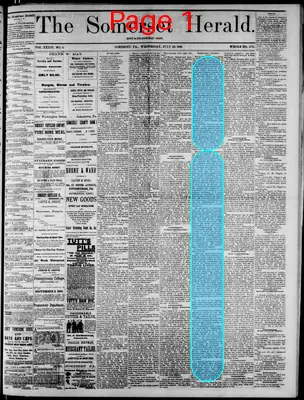
The Somerset Herald
Somerset, Somerset County, Pennsylvania
What is this article about?
Reflective essay on Abraham Lincoln as a providential leader during the Civil War, contrasting him with Washington, detailing his last speeches from the White House in April 1865, various personal anecdotes illustrating his sincerity and kindness, and concluding with the significance of his assassination.
Clipping

OCR Quality
Full Text
In every story, however insignificant, which is told of him, those who remember him personally recall the impression that he made. He was absolutely sincere. He never played a part. And therefore whatever he said and did was marked by his strong individuality. A correspondent in North Carolina gives the following:
"I heard Mr. Lincoln's last two speeches. One, extemporaneous, on Monday evening, April 10, from the historic front window in the second story of the White House. He had just returned from City Point, the people thronging around the White House would have a speech. For a good while he did not appear, and seemed reluctant to speak without a manuscript, lest at that critical juncture some injurious impression should be made by an accidental word or sentence.
"However, the crowd persisted to call till he appeared. It was my first sight of the man. He appeared somewhat younger and more off-hand and vigorous than I should have expected. His bright, knowing, somewhat humorous look reminded me of a well practiced country physician who had read men through till he understood them well. There was the humorous kindness of a good-natured doctor who had seen his patients through a most awful siege of sickness, till they were now fully and fairly convalescent, and was disposed to let the past, whatever it had cost him or them, go by for the time, and have a little cheerful congratulation. His gestures and expressions of countenance had something of the harmless satisfaction of a young politician at a ratification meeting after his first election to the Legislature. He was happy, and glad to see others happy, and willing to accept the congratulations of his friends for his own part in the general victory.
"His last speech, on Wednesday, April 12, was read from separate sheets, by a flaring light, as he stood at the same window. He wore eyeglasses; and as the separate pages were read passed them to a friend who stood near. It was perhaps eight o'clock in the evening: Mrs. Lincoln and several lady friends were standing at a side window. There was some talking and diversion during the reading. The reading was in a reading tone, but business-like and good, and the paper not long. It was intended to show the disposition of the administration toward the seceded States, and foreshadow the principles proposed for reconstruction. His manner was unpretentious but dignified, manly, kindly and vigorous."
The same friendly observer sends other Lincolnia:
"That rent,' said a soldier at the hospital at City Point, pointing up to the torn tissue paper--an embellishment which, I believe, the ladies of the Christian Commission had fixed on the ceiling above--'that was torn by Mr. Lincoln's hat as he passed through here on his way from Richmond, and shook hands with every man, loyal or rebel, in the whole hospital.' He stood, like Saul, above the people from the shoulders upward, and his hat made havoc with decorations overhead. Stepping outside, and seeing an axe by a log, his old rail-splitter spirit came over him. In a moment his long arms were putting home that axe toward the heart of the fallen tree. The boys in blue gathered those chips to take home as mementos of a backwoodsman who became President and the emancipator of a race.
An old sailor at the Soldiers' Home near Washington said, "He used to walk all about in these paths; he was very kind and familiar with us all."
To a poor woman who desired his signature to a paper, he said, "My name will do you no more good than pigs' tracks in the mud."
A soldier stopped him in the road against the Columbia Hospital, and presented some letters, desiring a furlough. He obtained it.
In the Senatorial contest between Mr. Lincoln and Mr. Douglas, when they spoke at Freeport, Illinois, Mr. Douglas appeared in an elegant barouche drawn by four white horses, and was received with great applause. But when Mr. Lincoln came up in a 'prairie schooner,' viz., an old-fashioned canvas-covered pioneer wagon, the enthusiasm of the vast throng was unbounded.
When travelling about the quiet country towns on his law business it was his custom, at the tavern or boarding-house where he stopped, after tea to get a candle and go to his room and read awhile. He was not a loafer.
At a political meeting in a grove, a long, shambling figure was seen sitting on the fence and whittling thoughtfully, clothed in the slightest of summer attire. After others had spoken, "Lincoln! Lincoln!" was called, and the whittler pocketed his knife, and slipped from the fence, made a characteristic speech. This was before his great prominence.
At the same place, when the lady who entertained him and some others at dinner made some apology, he said he guessed it was better than they would have got at home anyhow.
To Bishop Simpson, after a lecture on American progress, in which he did not speak of petroleum, Mr. Lincoln said as they came out, "You did not 'strike ile.'"
The sheet and clothes stained with the blood of Lincoln were literally torn in strips, as Anthony said of Caesar's, and preserved as mementos. The assassination of Caesar and of William of Orange were brought vividly to the minds of those who were in Washington. Only a day or two before the assassination, the Morning Chronicle, the Washington organ of the administration, said that a single life was seldom indispensable to a country, but that just then that of Abraham Lincoln seemed to be so.
It seemed to be so indeed. Yet he served his country by his death as by his life. Not only did his death at once prevent what might have been the dangerous consequences of a frenzy of exultation, but it taught us the most important of truths, that no man, however great and able and patriotic and devoted and beloved, is indispensable to the welfare of the country. There are extreme exigencies in which the natural cry is, "Oh, for an hour of Dundee!" But in the great development of liberty no one man is essential. As Charles Sumner said in beginning his eulogy upon Lincoln, "In the Providence of God there are no accidents."-Editor's Easy Chair, in Harper's Magazine for July.
What sub-type of article is it?
What themes does it cover?
What keywords are associated?
What entities or persons were involved?
Where did it happen?
Story Details
Key Persons
Location
White House, Washington; City Point; Freeport, Illinois
Event Date
April 10, 1865; April 12, 1865
Story Details
Collection of anecdotes highlighting Lincoln's sincerity, kindness, and providential leadership during the Civil War, from his last speeches and interactions with soldiers and civilians to reflections on his assassination and its lessons.