Thank you for visiting SNEWPapers!
Sign up free
The Woman's Tribune
Beatrice, Gage County, Nebraska
What is this article about?
Elizabeth L. Saxon reflects on her childhood playhouse, critiquing modern women's obsession with trivial home decorations over intellectual and social responsibilities. She urges women to rise to mental and spiritual planes, engage in organized efforts for reform, and address societal ills like immorality and crime, recalling past warnings about slavery's shadow on Southern womanhood.
Clipping
OCR Quality
Full Text
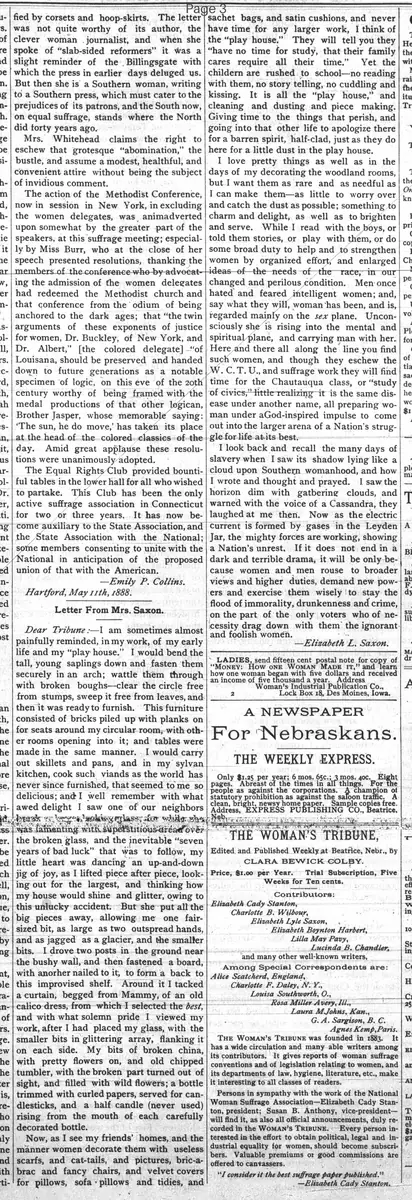
Dear Tribune: -I am sometimes almost painfully reminded, in my work, of my early life and my "play house." I would bend the tall, young saplings down and fasten them securely in an arch; wattle them through with broken boughs—clear the circle free from stumps, sweep it free from leaves, and then it was ready to furnish. This furniture consisted of bricks piled up with planks on for seats around my circular room, with other rooms opening into it; and tables were made in the same manner. I would carry out skillets and pans, and in my sylvan kitchen, cook such viands as the world has never since furnished, that seemed to me so delicious; and I well remember with what awed delight I saw one of our neighbors break a large looking glass for which she was lamenting with superstitious dread over the broken glass, and the inevitable "seven years of bad luck" that was to follow, my little heart was dancing an up-and-down jig of joy, as I lifted piece after piece, looking out for the largest, and thinking how my house would shine and glitter, owing to this unlucky accident. But she put all the big pieces away, allowing me one fair-sized bit, as large as two outspread hands, and as jagged as a glacier, and the smaller bits. I drove two posts in the ground near the bushy wall, and then fastened a board, with another nailed to it, to form a back to this improvised shelf. Around it I tacked a curtain, begged from Mammy, of an old calico dress, from which I selected the best, and with what solemn pride I viewed my work, after I had placed my glass, with the smaller bits in glittering array, flanking it on each side. My bits of broken china, with pretty flowers on, and old chipped tumbler, with the broken part turned out of sight, and filled with wild flowers; a bottle trimmed with curled papers, served for candlesticks, and a half candle (never used) rising from the mouth of each carefully decorated bottle.
Now, as I see my friends' homes, and the manner women decorate them with useless scarfs, and cat-tails, and pictures, bric-a-brac and fancy chairs, and velvet covers for pillows, sofa pillows and tidies, sachet bags, and satin cushions, and never have time for any larger work, I think of the "play house." They will tell you they "have no time for study, that their family cares require all their time." Yet the children are rushed to school—no reading with them, no story telling, no cuddling and kissing. It is all the "play house," and cleaning and dusting and piece making. Giving time to the things that perish, and going into that other life to apologize there for a barren spirit, half-clad, just as they do here for a little dust in the play house.
I love pretty things as well as in the days of my decorating the woodland rooms, but I want them as rare and as needful as I can make them—as little to worry over and catch the dust as possible; something to charm and delight, as well as to brighten and serve. While I read with the boys, or told them stories, or play with them, or do some broad duty to help and to strengthen women by organized effort, and enlarged ideas of the needs of the race, in our changed and perilous condition. Men once hated and feared intelligent women; and, say what they will, woman has been, and is, regarded mainly on the sex plane. Unconsciously she is rising into the mental and spiritual plane, and carrying man with her. Here and there all along the line you find such women, and though they eschew the W. C. T. U., and suffrage work they will find time for the Chautauqua class, or "study of civics," little realizing it is the same disease under another name, all preparing woman under a God-inspired impulse to come out into the larger arena of a Nation's struggle for life at its best.
I look back and recall the many days of slavery when I saw its shadow lying like a cloud upon Southern womanhood, and how I wrote and thought and prayed. I saw the horizon dim with gathering clouds, and warned with the voice of a Cassandra, they laughed at me then. Now as the electric current is formed by gases in the Leyden Jar, the mighty forces are working, showing a Nation's unrest. If it does not end in a dark and terrible drama, it will be only because women and men rouse to broader views and higher duties, demand new powers and exercise them wisely to stay the flood of immorality, drunkenness and crime, on the part of the only voters who of necessity drag down with them the ignorant and foolish women.
-Elizabeth L. Saxon.
What sub-type of article is it?
What themes does it cover?
What keywords are associated?
What entities or persons were involved?
Letter to Editor Details
Author
Elizabeth L. Saxon
Recipient
Dear Tribune
Main Argument
women waste time on trivial home decorations and domestic chores instead of pursuing intellectual growth, family engagement, and organized social reform to address broader issues like immorality and crime, rising from sex-based to mental and spiritual roles while recalling slavery's past impact on southern women.
Notable Details