Thank you for visiting SNEWPapers!
Sign up free
Literary
May 26, 1903
Evening Journal
Wilmington, New Castle County, Delaware
What is this article about?
Review article summarizing contents of June issues from magazines including National (stories on Washington, Porto Rico, slavery), Ainslee's (psychological studies), Century (political articles on Senate and Executive), Scribner's (short stories, serial on Civil War), and Ten Story Book (detective story by Pinkerton, other tales).
Clipping
OCR Quality
98%
Excellent
Full Text
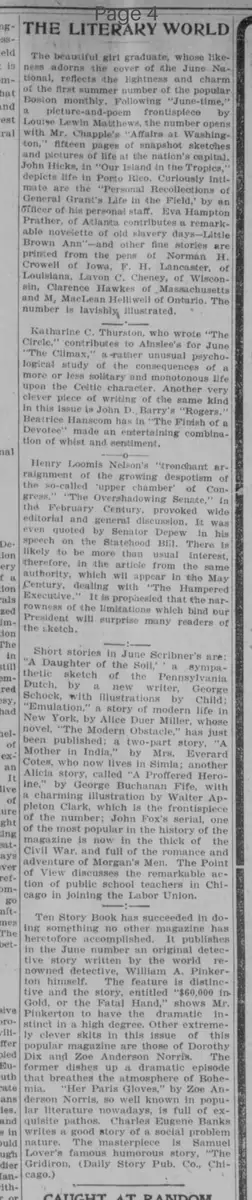
THE LITERARY WORLD
The beautiful girl graduate, whose likeness adorns the cover of the June National, reflects the lightness and charm of the first summer number of the popular Boston monthly. Following "June-time," a picture-and-poem frontispiece by Louise Lewin Matthews, the number opens with Mr. Chapple's "Affairs at Washington," fifteen pages of snapshot sketches and pictures of life at the nation's capital. John Hicks, in "Our Island in the Tropics," depicts life in Porto Rico. Curiously intimate are the "Personal Recollections of General Grant's Life in the Field," by an officer of his personal staff. Eva Hampton Prather, of Atlanta, contributes a remarkable novelette of old slavery days-"Little Brown Ann"-and other fine stories are printed from the pens of Norman H. Crowell of Iowa, F. H. Lancaster, of Louisiana, Lavon C. Cheney, of Wisconsin, Clarence Hawkes of Massachusetts and M. MacLean Helliwell of Ontario. The number is lavishly illustrated.
Katherine C. Thurston, who wrote "The Circle," contributes to Ainslee's for June "The Climax," a rather unusual psychological study of the consequences of a more or less solitary and monotonous life upon the Celtic character. Another very clever piece of writing of the same kind in this issue is John I. Barry's "Rogers." Beatrice Hanscom has in "The Finish of a Devotee" made an entertaining combination of whist and sentiment.
Henry Loomis Nelson's "trenchant arraignment of the growing despotism of the so-called 'upper chamber' of Congress," "The Overshadowing Senate," in the February Century, provoked wide editorial and general discussion. It was even quoted by Senator Depew in his speech on the Statehood Bill. There is likely to be more than usual interest, therefore, in the article from the same authority, which will appear in the May Century, dealing with "The Hampered Executive." It is prophesied that the narrowness of the limitations which bind our President will surprise many readers of the sketch.
Short stories in June Scribner's are: "A Daughter of the Soil," a sympathetic sketch of the Pennsylvania Dutch, by a new writer, George Schock, with illustrations by Child; "Emulation," a story of modern life in New York, by Alice Duer Miller, whose novel, "The Modern Obstacle," has just been published; a two-part story, "A Mother in India," by Mrs. Everard Cotes, who now lives in Simla; another Alicia story, called "A Proffered Heroine," by George Buchanan Fife, with a charming illustration by Walter Appleton Clark, which is the frontispiece of the number; John Fox's serial, one of the most popular in the history of the magazine, is now in the thick of the Civil War, and full of the romance and adventure of Morgan's Men. The Point of View discusses the remarkable action of public school teachers in Chicago in joining the Labor Union.
Ten Story Book has succeeded in doing something no other magazine has heretofore accomplished. It publishes in the June number an original detective story written by the world renowned detective, William A. Pinkerton himself. The feature is distinctive and the story, entitled "$60,000 in Gold, or the Fatal Hand," shows Mr. Pinkerton to have the dramatic instinct in a high degree. Other extremely clever skits in this issue of this popular magazine are those of Dorothy Dix and Zoe Anderson Norris. The former dishes up a dramatic episode that breathes the atmosphere of Bohemia. "Her Paris Gloves," by Zoe Anderson Norris, so well known in popular literature nowadays, is full of exquisite pathos. Charles Eugene Banks writes a good story of a social problem nature. The masterpiece is Samuel Lover's famous humorous story, "The Gridiron," (Daily Story Pub. Co., Chicago.)
The beautiful girl graduate, whose likeness adorns the cover of the June National, reflects the lightness and charm of the first summer number of the popular Boston monthly. Following "June-time," a picture-and-poem frontispiece by Louise Lewin Matthews, the number opens with Mr. Chapple's "Affairs at Washington," fifteen pages of snapshot sketches and pictures of life at the nation's capital. John Hicks, in "Our Island in the Tropics," depicts life in Porto Rico. Curiously intimate are the "Personal Recollections of General Grant's Life in the Field," by an officer of his personal staff. Eva Hampton Prather, of Atlanta, contributes a remarkable novelette of old slavery days-"Little Brown Ann"-and other fine stories are printed from the pens of Norman H. Crowell of Iowa, F. H. Lancaster, of Louisiana, Lavon C. Cheney, of Wisconsin, Clarence Hawkes of Massachusetts and M. MacLean Helliwell of Ontario. The number is lavishly illustrated.
Katherine C. Thurston, who wrote "The Circle," contributes to Ainslee's for June "The Climax," a rather unusual psychological study of the consequences of a more or less solitary and monotonous life upon the Celtic character. Another very clever piece of writing of the same kind in this issue is John I. Barry's "Rogers." Beatrice Hanscom has in "The Finish of a Devotee" made an entertaining combination of whist and sentiment.
Henry Loomis Nelson's "trenchant arraignment of the growing despotism of the so-called 'upper chamber' of Congress," "The Overshadowing Senate," in the February Century, provoked wide editorial and general discussion. It was even quoted by Senator Depew in his speech on the Statehood Bill. There is likely to be more than usual interest, therefore, in the article from the same authority, which will appear in the May Century, dealing with "The Hampered Executive." It is prophesied that the narrowness of the limitations which bind our President will surprise many readers of the sketch.
Short stories in June Scribner's are: "A Daughter of the Soil," a sympathetic sketch of the Pennsylvania Dutch, by a new writer, George Schock, with illustrations by Child; "Emulation," a story of modern life in New York, by Alice Duer Miller, whose novel, "The Modern Obstacle," has just been published; a two-part story, "A Mother in India," by Mrs. Everard Cotes, who now lives in Simla; another Alicia story, called "A Proffered Heroine," by George Buchanan Fife, with a charming illustration by Walter Appleton Clark, which is the frontispiece of the number; John Fox's serial, one of the most popular in the history of the magazine, is now in the thick of the Civil War, and full of the romance and adventure of Morgan's Men. The Point of View discusses the remarkable action of public school teachers in Chicago in joining the Labor Union.
Ten Story Book has succeeded in doing something no other magazine has heretofore accomplished. It publishes in the June number an original detective story written by the world renowned detective, William A. Pinkerton himself. The feature is distinctive and the story, entitled "$60,000 in Gold, or the Fatal Hand," shows Mr. Pinkerton to have the dramatic instinct in a high degree. Other extremely clever skits in this issue of this popular magazine are those of Dorothy Dix and Zoe Anderson Norris. The former dishes up a dramatic episode that breathes the atmosphere of Bohemia. "Her Paris Gloves," by Zoe Anderson Norris, so well known in popular literature nowadays, is full of exquisite pathos. Charles Eugene Banks writes a good story of a social problem nature. The masterpiece is Samuel Lover's famous humorous story, "The Gridiron," (Daily Story Pub. Co., Chicago.)
What sub-type of article is it?
Essay
What themes does it cover?
Political
What keywords are associated?
Magazine Review
Short Stories
Political Articles
Serial Fiction
Detective Story
Literary Details
Title
The Literary World
Subject
Review Of June Magazine Issues
Form / Style
Prose Review Of Literary Publications