Thank you for visiting SNEWPapers!
Sign up free
Literary
October 21, 1932
The Indian Leader
Lawrence, Douglas County, Kansas
What is this article about?
Dakota Indian legend of Wakinyan Sapa (Black Thunder) whose jealous wife Ite Ika (Smiling Face) turns to stone while standing with her child during a village move, explaining the origin of Standing Rock reservation's name. Attributed to Louisa Long Soldier.
Clipping
OCR Quality
98%
Excellent
Full Text
INDIAN LEGEND OF STANDING ROCK
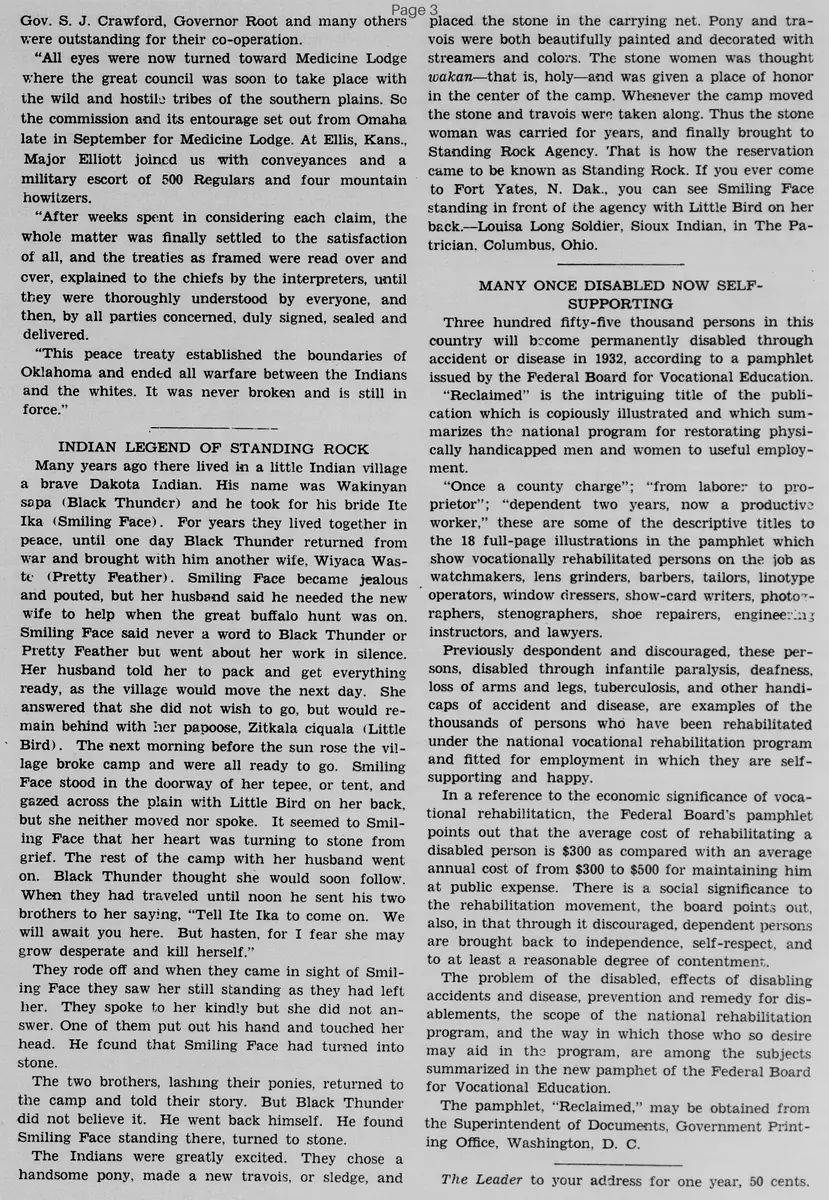
Many years ago there lived in a little Indian village a brave Dakota Indian. His name was Wakinyan sapa (Black Thunder) and he took for his bride Ite Ika (Smiling Face). For years they lived together in peace, until one day Black Thunder returned from war and brought with him another wife, Wiyaca Washte (Pretty Feather). Smiling Face became jealous and pouted, but her husband said he needed the new wife to help when the great buffalo hunt was on. Smiling Face said never a word to Black Thunder or Pretty Feather but went about her work in silence. Her husband told her to pack and get everything ready, as the village would move the next day. She answered that she did not wish to go, but would remain behind with her papoose, Zitkala ciquala (Little Bird). The next morning before the sun rose the village broke camp and were all ready to go. Smiling Face stood in the doorway of her tepee, or tent, and gazed across the plain with Little Bird on her back. But she neither moved nor spoke. It seemed to Smiling Face that her heart was turning to stone from grief. The rest of the camp with her husband went on. Black Thunder thought she would soon follow. When they had traveled until noon he sent his two brothers to her saying, "Tell Ite Ika to come on. We will await you here. But hasten, for I fear she may grow desperate and kill herself."
They rode off and when they came in sight of Smiling Face they saw her still standing as they had left her. They spoke to her kindly but she did not answer. One of them put out his hand and touched her head. He found that Smiling Face had turned into stone.
The two brothers, lashing their ponies, returned to the camp and told their story. But Black Thunder did not believe it. He went back himself. He found Smiling Face standing there, turned to stone. The Indians were greatly excited. They chose a handsome pony, made a new travois, or sledge, and placed the stone in the carrying net. Pony and travois were both beautifully painted and decorated with streamers and colors. The stone woman was thought wakan, that is, holy-and was given a place of honor in the center of the camp. Whenever the camp moved the stone and travois were taken along. Thus the stone woman was carried for years, and finally brought to Standing Rock Agency. That is how the reservation came to be known as Standing Rock. If you ever come to Fort Yates, N. Dak., you can see Smiling Face standing in front of the agency with Little Bird on her back.-Louisa Long Soldier, Sioux Indian, in The Patrician. Columbus, Ohio.
What sub-type of article is it?
Prose Fiction
What themes does it cover?
Moral Virtue
Love Romance
What keywords are associated?
Dakota Legend
Standing Rock
Jealousy
Turning To Stone
Black Thunder
Smiling Face
Sioux Indian
What entities or persons were involved?
Louisa Long Soldier, Sioux Indian, In The Patrician. Columbus, Ohio.
Literary Details
Title
Indian Legend Of Standing Rock
Author
Louisa Long Soldier, Sioux Indian, In The Patrician. Columbus, Ohio.
Subject
Legend Explaining The Origin Of Standing Rock Reservation
Key Lines
One Of Them Put Out His Hand And Touched Her Head. He Found That Smiling Face Had Turned Into Stone.
That Is How The Reservation Came To Be Known As Standing Rock.
If You Ever Come To Fort Yates, N. Dak., You Can See Smiling Face Standing In Front Of The Agency With Little Bird On Her Back.