Thank you for visiting SNEWPapers!
Sign up free
Editorial
July 22, 1901
The Indianapolis Journal
Indianapolis, Marion County, Indiana
What is this article about?
This editorial from the Philadelphia Record critiques the notion of 'learned professions' in modern times, arguing that specialization in fields like medicine, law, journalism, preaching, and pedagogy has replaced comprehensive classical learning with narrow expertise, leaving no room for Renaissance-like polymaths.
Clipping
OCR Quality
95%
Excellent
Full Text
"THE LEARNED PROFESSIONS."
The Term Hardly Belongs to Any Profession Now,
Philadelphia Record.
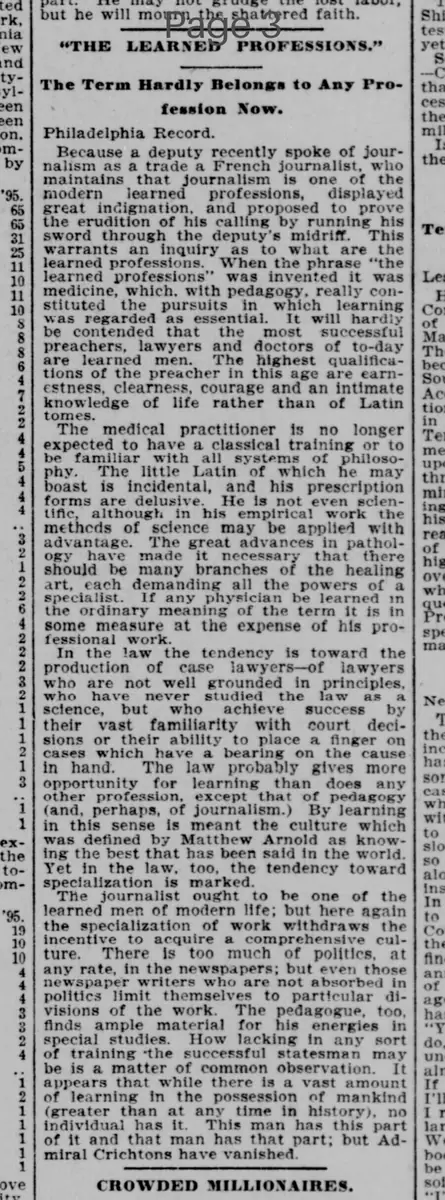
Because a deputy recently spoke of journalism as a trade a French journalist, who maintains that journalism is one of the modern learned professions, displayed great indignation, and proposed to prove the erudition of his calling by running his sword through the deputy's midriff. This warrants an inquiry as to what are the learned professions. When the phrase "the learned professions" was invented it was medicine, which, with pedagogy, really constituted the pursuits in which learning was regarded as essential. It will hardly be contended that the most successful preachers, lawyers and doctors of to-day are learned men. The highest qualifications of the preacher in this age are earnestness, clearness, courage and an intimate knowledge of life rather than of Latin tomes. The medical practitioner is no longer expected to have a classical training or to be familiar with all systems of philosophy. The little Latin of which he may boast is incidental, and his prescription forms are delusive. He is not even scientific, although in his empirical work the methods of science may be applied with advantage. The great advances in pathology that there should be many branches of the healing art, each demanding all the powers of a specialist. If any physician be learned in the ordinary meaning of the term it is in some measure at the expense of his professional work.
In the law the tendency is toward the production of case lawyers-of lawyers who are not well grounded in principles, who have never studied the law as a science, but who achieve success by their vast familiarity with court decisions or their ability to place a finger on cases which have a bearing on the cause in hand. The law probably gives more opportunity for learning than does any other profession, except that of pedagogy (and, perhaps, of journalism.) By learning in this sense is meant the culture which was defined by Matthew Arnold as knowing the best that has been said in the world. Yet in the law, too, the tendency toward specialization is marked.
The journalist ought to be one of the learned men of modern life; but here again the specialization of work withdraws the incentive to acquire a comprehensive culture. There is too much of politics, at any rate, in the newspapers; but even those newspaper writers who are not absorbed in politics limit themselves to particular divisions of the work. The pedagogue, too, finds ample material for his energies in special studies. How lacking in any sort of training the successful statesman may be is a matter of common observation. It appears that while there is a vast amount of learning in the possession of mankind (greater than at any time in history), no individual has it. This man has this part of it and that man has that part; but Admiral Crichtons have vanished.
The Term Hardly Belongs to Any Profession Now,
Philadelphia Record.
Because a deputy recently spoke of journalism as a trade a French journalist, who maintains that journalism is one of the modern learned professions, displayed great indignation, and proposed to prove the erudition of his calling by running his sword through the deputy's midriff. This warrants an inquiry as to what are the learned professions. When the phrase "the learned professions" was invented it was medicine, which, with pedagogy, really constituted the pursuits in which learning was regarded as essential. It will hardly be contended that the most successful preachers, lawyers and doctors of to-day are learned men. The highest qualifications of the preacher in this age are earnestness, clearness, courage and an intimate knowledge of life rather than of Latin tomes. The medical practitioner is no longer expected to have a classical training or to be familiar with all systems of philosophy. The little Latin of which he may boast is incidental, and his prescription forms are delusive. He is not even scientific, although in his empirical work the methods of science may be applied with advantage. The great advances in pathology that there should be many branches of the healing art, each demanding all the powers of a specialist. If any physician be learned in the ordinary meaning of the term it is in some measure at the expense of his professional work.
In the law the tendency is toward the production of case lawyers-of lawyers who are not well grounded in principles, who have never studied the law as a science, but who achieve success by their vast familiarity with court decisions or their ability to place a finger on cases which have a bearing on the cause in hand. The law probably gives more opportunity for learning than does any other profession, except that of pedagogy (and, perhaps, of journalism.) By learning in this sense is meant the culture which was defined by Matthew Arnold as knowing the best that has been said in the world. Yet in the law, too, the tendency toward specialization is marked.
The journalist ought to be one of the learned men of modern life; but here again the specialization of work withdraws the incentive to acquire a comprehensive culture. There is too much of politics, at any rate, in the newspapers; but even those newspaper writers who are not absorbed in politics limit themselves to particular divisions of the work. The pedagogue, too, finds ample material for his energies in special studies. How lacking in any sort of training the successful statesman may be is a matter of common observation. It appears that while there is a vast amount of learning in the possession of mankind (greater than at any time in history), no individual has it. This man has this part of it and that man has that part; but Admiral Crichtons have vanished.
What sub-type of article is it?
Education
What keywords are associated?
Learned Professions
Specialization
Journalism
Medicine
Law
Pedagogy
What entities or persons were involved?
Matthew Arnold
Admiral Crichtons
Editorial Details
Primary Topic
Decline Of Learned Professions Due To Specialization
Stance / Tone
Reflective Critique
Key Figures
Matthew Arnold
Admiral Crichtons
Key Arguments
Modern Professions Prioritize Practical Skills Over Classical Learning
Specialization In Medicine Limits Broad Erudition
Lawyers Succeed Through Case Familiarity Rather Than Principled Study
Journalism And Pedagogy Also Suffer From Specialization
No Individual Possesses Comprehensive Learning In The Modern Era