Thank you for visiting SNEWPapers!
Sign up free
Editorial
July 22, 1864
The Liberator
Boston, Suffolk County, Massachusetts
What is this article about?
Editorial critiques the General Association of Orthodox Congregational Ministers of Massachusetts for superficially commending the anti-slavery American Missionary Association while continuing support for the pro-slavery American Board, revealing their unchanged stance on slavery amid shifting public opinion.
Clipping
OCR Quality
98%
Excellent
Full Text
The Liberator.
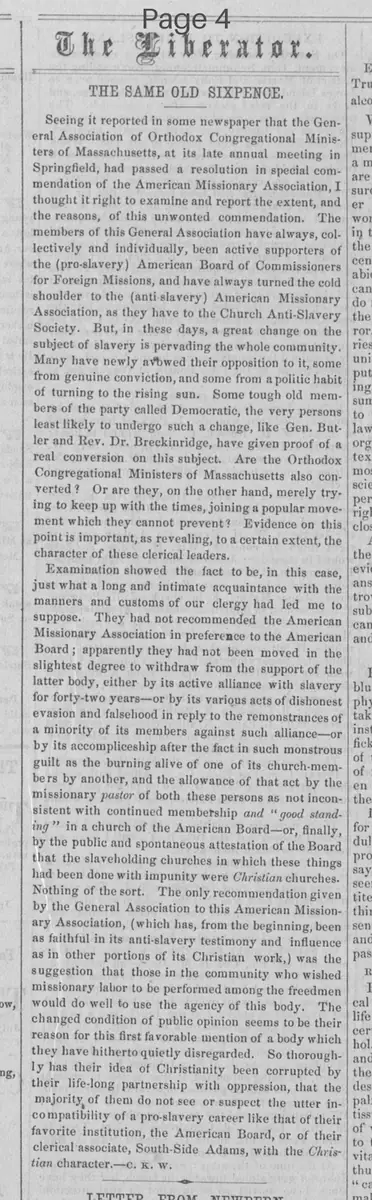
THE SAME OLD SIXPENCE,
Seeing it reported in some newspaper that the General Association of Orthodox Congregational Ministers of Massachusetts, at its late annual meeting in Springfield, had passed a resolution in special commendation of the American Missionary Association, I thought it right to examine and report the extent, and the reasons, of this unwonted commendation. The members of this General Association have always, collectively and individually, been active supporters of the (pro-slavery) American Board of Commissioners for Foreign Missions, and have always turned the cold shoulder to the (anti-slavery) American Missionary Association, as they have to the Church Anti-Slavery Society. But, in these days, a great change on the subject of slavery is pervading the whole community. Many have newly avowed their opposition to it, some from genuine conviction, and some from a politic habit of turning to the rising sun. Some tough old members of the party called Democratic, the very persons least likely to undergo such a change, like Gen. Butler and Rev. Dr. Breckinridge, have given proof of a real conversion on this subject. Are the Orthodox Congregational Ministers of Massachusetts also converted? Or are they, on the other hand, merely trying to keep up with the times, joining a popular movement which they cannot prevent? Evidence on this point is important, as revealing, to a certain extent, the character of these clerical leaders.
Examination showed the fact to be, in this case, just what a long and intimate acquaintance with the manners and customs of our clergy had led me to suppose. They had not recommended the American Missionary Association in preference to the American Board; apparently they had not been moved in the slightest degree to withdraw from the support of the latter body, either by its active alliance with slavery for forty-two years—or by its various acts of dishonest evasion and falsehood in reply to the remonstrances of a minority of its members against such alliance—or by its accompliceship after the fact in such monstrous guilt as the burning alive of one of its church-members by another, and the allowance of that act by the missionary pastor of both these persons as not inconsistent with continued membership and "good standing" in a church of the American Board—or, finally, by the public and spontaneous attestation of the Board that the slaveholding churches in which these things had been done with impunity were Christian churches.
Nothing of the sort. The only recommendation given by the General Association to this American Missionary Association, (which has, from the beginning, been as faithful in its anti-slavery testimony and influence as in other portions of its Christian work,) was the suggestion that those in the community who wished missionary labor to be performed among the freedmen would do well to use the agency of this body. The changed condition of public opinion seems to be their reason for this first favorable mention of a body which they have hitherto quietly disregarded. So thoroughly has their idea of Christianity been corrupted by their life-long partnership with oppression, that the majority of them do not see or suspect the utter incompatibility of a pro-slavery career like that of their favorite institution, the American Board, or of their clerical associate, South-Side Adams, with the Christian character.—C. K. W.
THE SAME OLD SIXPENCE,
Seeing it reported in some newspaper that the General Association of Orthodox Congregational Ministers of Massachusetts, at its late annual meeting in Springfield, had passed a resolution in special commendation of the American Missionary Association, I thought it right to examine and report the extent, and the reasons, of this unwonted commendation. The members of this General Association have always, collectively and individually, been active supporters of the (pro-slavery) American Board of Commissioners for Foreign Missions, and have always turned the cold shoulder to the (anti-slavery) American Missionary Association, as they have to the Church Anti-Slavery Society. But, in these days, a great change on the subject of slavery is pervading the whole community. Many have newly avowed their opposition to it, some from genuine conviction, and some from a politic habit of turning to the rising sun. Some tough old members of the party called Democratic, the very persons least likely to undergo such a change, like Gen. Butler and Rev. Dr. Breckinridge, have given proof of a real conversion on this subject. Are the Orthodox Congregational Ministers of Massachusetts also converted? Or are they, on the other hand, merely trying to keep up with the times, joining a popular movement which they cannot prevent? Evidence on this point is important, as revealing, to a certain extent, the character of these clerical leaders.
Examination showed the fact to be, in this case, just what a long and intimate acquaintance with the manners and customs of our clergy had led me to suppose. They had not recommended the American Missionary Association in preference to the American Board; apparently they had not been moved in the slightest degree to withdraw from the support of the latter body, either by its active alliance with slavery for forty-two years—or by its various acts of dishonest evasion and falsehood in reply to the remonstrances of a minority of its members against such alliance—or by its accompliceship after the fact in such monstrous guilt as the burning alive of one of its church-members by another, and the allowance of that act by the missionary pastor of both these persons as not inconsistent with continued membership and "good standing" in a church of the American Board—or, finally, by the public and spontaneous attestation of the Board that the slaveholding churches in which these things had been done with impunity were Christian churches.
Nothing of the sort. The only recommendation given by the General Association to this American Missionary Association, (which has, from the beginning, been as faithful in its anti-slavery testimony and influence as in other portions of its Christian work,) was the suggestion that those in the community who wished missionary labor to be performed among the freedmen would do well to use the agency of this body. The changed condition of public opinion seems to be their reason for this first favorable mention of a body which they have hitherto quietly disregarded. So thoroughly has their idea of Christianity been corrupted by their life-long partnership with oppression, that the majority of them do not see or suspect the utter incompatibility of a pro-slavery career like that of their favorite institution, the American Board, or of their clerical associate, South-Side Adams, with the Christian character.—C. K. W.
What sub-type of article is it?
Slavery Abolition
Moral Or Religious
What keywords are associated?
Anti Slavery Missions
Pro Slavery Board
Clerical Hypocrisy
American Missionary Association
Orthodox Ministers
Slavery Conversion
Freedmen Missions
What entities or persons were involved?
General Association Of Orthodox Congregational Ministers Of Massachusetts
American Missionary Association
American Board Of Commissioners For Foreign Missions
Gen. Butler
Rev. Dr. Breckinridge
South Side Adams
C. K. W.
Editorial Details
Primary Topic
Critique Of Ministers' Superficial Anti Slavery Stance
Stance / Tone
Strongly Critical Of Clerical Hypocrisy On Slavery
Key Figures
General Association Of Orthodox Congregational Ministers Of Massachusetts
American Missionary Association
American Board Of Commissioners For Foreign Missions
Gen. Butler
Rev. Dr. Breckinridge
South Side Adams
C. K. W.
Key Arguments
Ministers Have Long Supported Pro Slavery American Board While Ignoring Anti Slavery American Missionary Association
Their Recent Commendation Is Limited To Suggesting It For Freedmen Missions, Not A Full Endorsement
Public Opinion Shift Prompts This Superficial Change, Not Genuine Conversion
American Board's 42 Year Alliance With Slavery, Evasions, And Tolerance Of Atrocities Unchanged
Clergy's Christianity Corrupted By Partnership With Oppression