Thank you for visiting SNEWPapers!
Sign up free
The Rhode Island Republican
Newport, Newport County, Rhode Island
What is this article about?
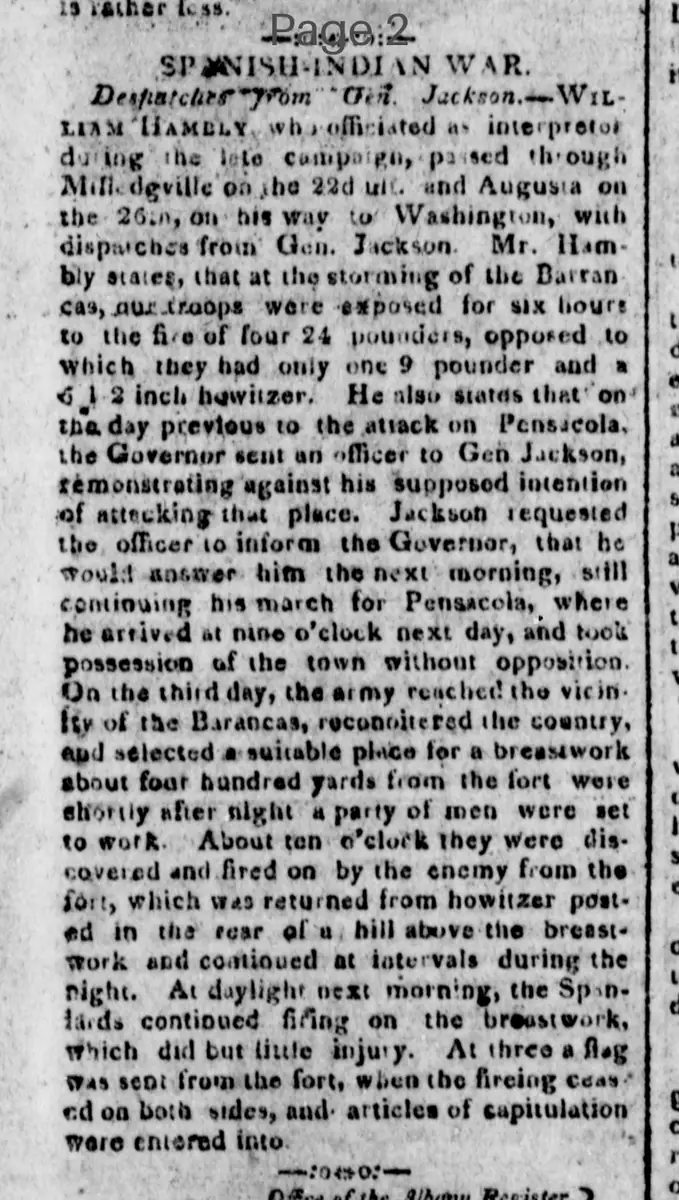
At the storming of the Barrancas, our troops were exposed for six hours to the fire of four 24 pounders, opposed to which they had only one 9 pounder and a 6 1/2 inch howitzer. On the day previous to the attack on Pensacola, the Governor sent an officer to Gen Jackson, remonstrating against his supposed intention of attacking that place. Jackson requested the officer to inform the Governor, that he would answer him the next morning, still continuing his march for Pensacola, where he arrived at nine o'clock next day, and took possession of the town without opposition. On the third day, the army reached the vicinity of the Barancas, reconnoitered the country, and selected a suitable place for a breastwork about four hundred yards from the fort where shortly after night a party of men were set to work. About ten o'clock they were discovered and fired on by the enemy from the fort, which was returned from howitzer posted in the rear of a hill above the breastwork and continued at intervals during the night. At daylight next morning, the Spaniards continued firing on the breastwork, which did but little injury. At three a flag was sent from the fort, when the firing ceased on both sides, and articles of capitulation were entered into.
Clipping
OCR Quality
Full Text
This is Event 1 of 2. The full text below covers all events in this component.
Despatches from Gen. Jackson. WILLIAM HAMBLY, who officiated as interpreter during the late campaign, passed through Milledgeville on the 22d ult. and Augusta on the 26th, on his way to Washington, with despatches from Gen. Jackson. Mr. Hambly states, that at the storming of the Barrancas, our troops were exposed for six hours to the fire of four 24 pounders, opposed to which they had only one 9 pounder and a 6 1/2 inch howitzer. He also states that on the day previous to the attack on Pensacola, the Governor sent an officer to Gen Jackson, remonstrating against his supposed intention of attacking that place. Jackson requested the officer to inform the Governor, that he would answer him the next morning, still continuing his march for Pensacola, where he arrived at nine o'clock next day, and took possession of the town without opposition. On the third day, the army reached the vicinity of the Barancas, reconnoitered the country, and selected a suitable place for a breastwork about four hundred yards from the fort where shortly after night a party of men were set to work. About ten o'clock they were discovered and fired on by the enemy from the fort, which was returned from howitzer posted in the rear of a hill above the breastwork and continued at intervals during the night. At daylight next morning, the Spaniards continued firing on the breastwork, which did but little injury. At three a flag was sent from the fort, when the firing ceased on both sides, and articles of capitulation were entered into.
What sub-type of article is it?
What keywords are associated?
What entities or persons were involved?
Where did it happen?
Foreign News Details
Primary Location
Pensacola
Event Date
Previous To The Attack On Pensacola
Key Persons
Outcome
took possession of the town without opposition; articles of capitulation were entered into
Event Details
At the storming of the Barrancas, our troops were exposed for six hours to the fire of four 24 pounders, opposed to which they had only one 9 pounder and a 6 1/2 inch howitzer. On the day previous to the attack on Pensacola, the Governor sent an officer to Gen Jackson, remonstrating against his supposed intention of attacking that place. Jackson requested the officer to inform the Governor, that he would answer him the next morning, still continuing his march for Pensacola, where he arrived at nine o'clock next day, and took possession of the town without opposition. On the third day, the army reached the vicinity of the Barancas, reconnoitered the country, and selected a suitable place for a breastwork about four hundred yards from the fort where shortly after night a party of men were set to work. About ten o'clock they were discovered and fired on by the enemy from the fort, which was returned from howitzer posted in the rear of a hill above the breastwork and continued at intervals during the night. At daylight next morning, the Spaniards continued firing on the breastwork, which did but little injury. At three a flag was sent from the fort, when the firing ceased on both sides, and articles of capitulation were entered into.