Thank you for visiting SNEWPapers!
Sign up free
The Weekly Gazette
East Hartford, Hartford County, Connecticut
What is this article about?
In Budapest, excavations in the Roman site of Aquincum uncovered the first known physical example of a Roman water-organ, the largest ancient musical instrument, dating to 228 A.D. and belonging to a college. Reconstruction is planned using classical texts.
Clipping
OCR Quality
Full Text
Unearthed in Budapest
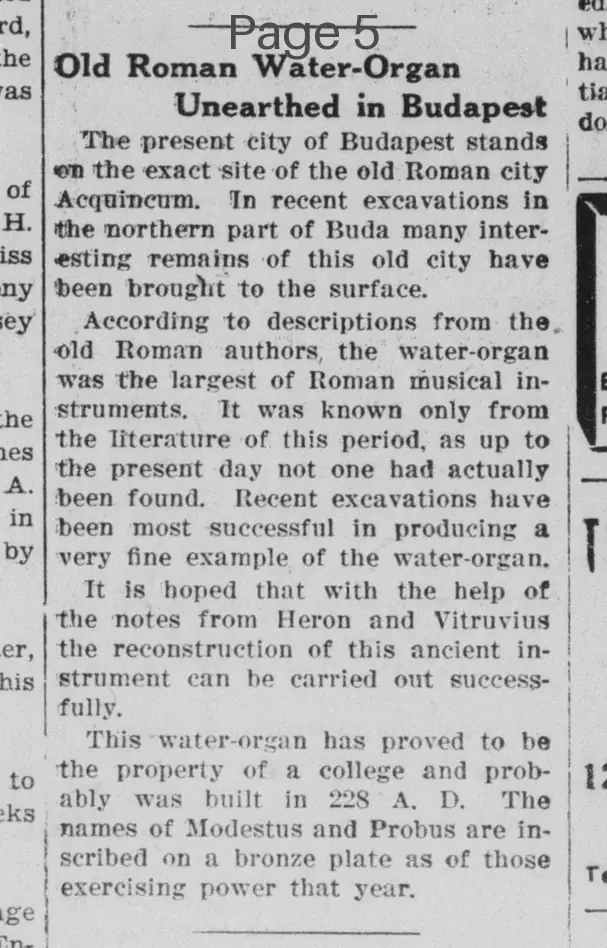
The present city of Budapest stands on the exact site of the old Roman city Acquincum. In recent excavations in the northern part of Buda many interesting remains of this old city have been brought to the surface.
According to descriptions from the old Roman authors, the water-organ was the largest of Roman musical instruments. It was known only from the literature of this period, as up to the present day not one had actually been found. Recent excavations have been most successful in producing a very fine example of the water-organ.
It is hoped that with the help of the notes from Heron and Vitruvius the reconstruction of this ancient instrument can be carried out successfully.
This water-organ has proved to be the property of a college and probably was built in 228 A. D. The names of Modestus and Probus are inscribed on a bronze plate as of those exercising power that year.
What sub-type of article is it?
What keywords are associated?
What entities or persons were involved?
Where did it happen?
Foreign News Details
Primary Location
Budapest
Key Persons
Outcome
unearthed a very fine example of a roman water-organ, the first physical specimen found; built in 228 a.d. as property of a college; inscribed with names of modestus and probus; hopes for successful reconstruction using notes from heron and vitruvius.
Event Details
The present city of Budapest stands on the exact site of the old Roman city Acquincum. In recent excavations in the northern part of Buda many interesting remains of this old city have been brought to the surface. According to descriptions from the old Roman authors, the water-organ was the largest of Roman musical instruments. It was known only from the literature of this period, as up to the present day not one had actually been found. Recent excavations have been most successful in producing a very fine example of the water-organ. It is hoped that with the help of the notes from Heron and Vitruvius the reconstruction of this ancient instrument can be carried out successfully. This water-organ has proved to be the property of a college and probably was built in 228 A. D. The names of Modestus and Probus are inscribed on a bronze plate as of those exercising power that year.