Thank you for visiting SNEWPapers!
Sign up free
Canton Herald
Canton, Madison County, Mississippi
What is this article about?
A satirical letter harshly criticizes Andrew Jackson's presidency as a 'national mob' that ruined the nation's character and institutions, driven by his domineering personality and personal vendetta against the national bank and Nicholas Biddle. It also attacks Congressman John F. H. Claiborne for political inconsistency and lack of integrity.
Merged-components note: Continuation of the same letter to the editor criticizing the Jackson administration.
Clipping
OCR Quality
Full Text
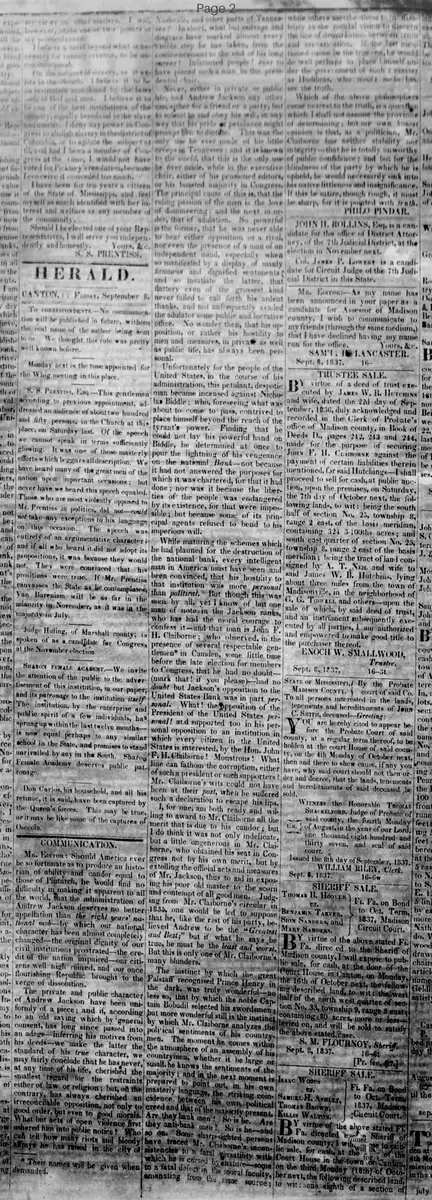
The private and public character of Andrew Jackson have been uniformly of a piece; and if, according to an old saying which by general consent, has long since passed into an adage—inferring his motives from his deeds—we make the latter the standard of his true character, we may fairly conclude that he has never, at any time of his life, cherished the smallest regard for the restraints either of law or religion; but, on the contrary has always cherished an irreconcilable opposition, not only to good order, but even to good morals.
What but acts of open violence first ushered him into public notice! Who can tell how many riots and bloody affrays he has raised in the city of Nashville, and other parts of Tennessee!
In short, what but intrigue and intriguing have marked every step he has taken, from the commencement to the end of his long career! Infatuated people have placed such a man in the presidential chair.
Never, either in private or public life, had Andrew Jackson any other deity, either for a friend or a party, but his own will; in any way that his pride or petulance might prompt him to dictate.
This was the only use he ever made of his little efforts in Tennessee; and it is known to the world, that this is the only use he ever made, while in the executive chair, either of his pensioned editors, or his boasted majority in Congress.
The principal cause of this is, that the ruling passion of the man is the love of domineering; and the next in order, that of adulation. So powerful is the former, that he was never able to bear either opposition or a rival, nor even the presence of a man of an independent mind, especially when so manifested by a display of manly firmness and dignified sentiments; and so insatiate the latter, that flattery even of the grossest kind never failed to call forth his ardent thanks, and not unfrequently availed the adulator some public and lucrative office. No wonder then, that his opposition, or rather his hostility to men and measures, in private as well as public life, has always been personal.
Unfortunately for the people of the United States, in the course of his administration, this petulant, despotic man became incensed against Nicholas Biddle; who, foreseeing what was about to come to pass, contrived to place himself beyond the reach of the tyrant's power. Finding that he could not lay his powerful hand on Biddle, he determined at once to pour the lightning of his vengeance on the national Bank—not because it had not answered the purposes for which it was chartered, for that it had done; nor was it because the liberties of the people was endangered by its existence, for that were impossible; but because some of its principal agents refused to bend to his imperious will.
While maturing the schemes which he had planned for the destruction of the national bank, every intelligent man in America must have seen and been convinced, that his hostility to that institution was more personal than political. But though this was seen by all, yet I know of but one man of note in the Jackson ranks, who has had the moral courage to confess it—and that man is John F. H. Claiborne: who observed, in the presence of several respectable gentlemen in Camden, some little time before the late election for members to Congress, that he had no doubt—(mark that! if you please)—had no doubt but Jackson's opposition to the United States Bank was in part personal. What! the opposition of the President of the United States personal! and supported too in his personal opposition to an institution in which every citizen in the United States is interested, by the Hon. John F. H. Claiborne! Monstrous! What line can fathom the corruption, either of such a president or such supporters? Mr. Claiborne's wits could not have been at their post, when he suffered such a declaration to escape his lips. I, for one, am both ready and willing to award to Mr. Claiborne all the merit that is due to his candor; but I do think it was not only indelicate, but a little ungenerous in Mr. Claiborne, who obtained his seat in Congress not by his own merit, but by extolling the official acts and measures of Mr. Jackson, thus to aid in exposing his poor old master to the scorn and contempt of all good men. Judging from Mr. Claiborne's circular in 1835, one would be led to suppose that he, like the rest of his party, believed Andrew to be the "Greatest and Best;" but if what he says be true, he must be the least and worst. But this is only one of Mr. Claiborne's many blunders.
The instinct by which the great Falstaff recognised Prince Henry, in the dark, was truly wonderful; no less so, that by which the noble Captain Bobadil selected his swordsmen; but more wonderful still is the instinct by which Mr. Claiborne analyzes the political sentiments of his countrymen. The moment he comes within the atmosphere of an assembly of his countrymen, whether it be large or small, he knows the sentiments of the majority; and in the next moment is prepared to point out, in his own masterly language, the striking coincidence between his own political creed and that of the majority present. Are they bank men? So is he. Are they anti-bank men? So is he—and so on. Some sharp-sighted persons have traced Mr. Claiborne's inconsistencies to a fatal versatility with which he is cursed by nature; some to a fatal defect in his moral faculty, emanating from the same source; while others ascribe them to a total inability to discern the line of demarkation, between truth and prevarication.
If the last mentioned cause be the true one, he would do well perhaps to place himself under the government of such a master who would make him see the truth.
Which of the above philosophers comes nearest to the truth, is a question which I shall not assume the province of determining; but my own honest opinion is, that Mr. Claiborne has neither stability nor integrity—that he is totally unworthy of public confidence; and but for the blindness of the party by which he is upheld, he would necessarily sink into his native littleness and insignificance.
If this be satire, though rough, it must be sharp, for it is pointed with truth.
PHULO PINDAR.
What sub-type of article is it?
What themes does it cover?
What keywords are associated?
What entities or persons were involved?
Letter to Editor Details
Author
Phulo Pindar
Recipient
Mr. Editor
Main Argument
andrew jackson's administration was a disastrous 'national mob' that degraded the nation's character, institutions, and economy due to his violent, domineering personality and personal grudge against the national bank, as admitted partially by supporter john f. h. claiborne, who is also criticized for inconsistency and lack of integrity.
Notable Details