Thank you for visiting SNEWPapers!
Sign up free
Letter to Editor
September 5, 1839
Martinsburg Gazette
Martinsburg, Berkeley County, West Virginia
What is this article about?
A letter from Baltimore dated August 26, 1839, reflects on the shift from wagon trade to railroads benefiting farmers in the Potomac region, reports on a mob incident over a nun's escape resolved peacefully, and describes the enthusiastic welcome for Henry Clay's visit.
Clipping
OCR Quality
95%
Excellent
Full Text
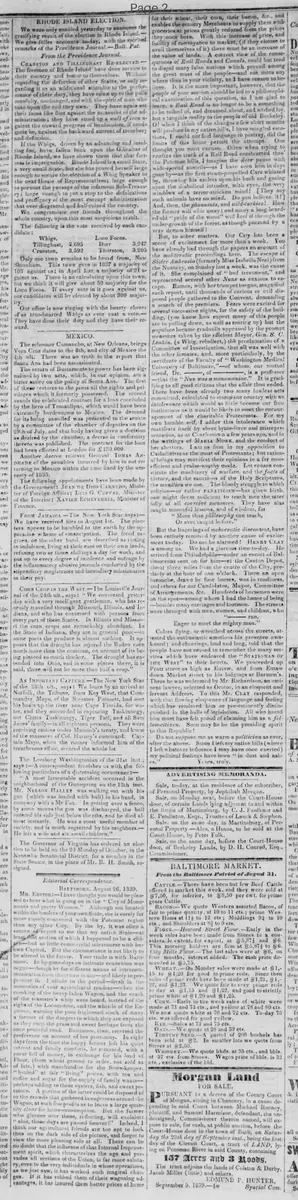
Editorial Correspondence.
Baltimore, August 26, 1839.
Mr. Editor:—I have thought you would be pleased to hear what is going on in the "City of Monuments and pretty Women." Although not located within the borders of your own State, she is surely far more closely connected with the Potomac region than any other City. By the by, it was often a source of regret to me that my native State—at least that section of which I happened to be a citizen—had so little commercial intercourse with her own Capitol. But the circumstance is not likely to be altered in the future. Your trade is with Baltimore. In by-gone days an intimate connexion was begun—though by far different means of intercommunication from those now in use—and likely to perpetuate it. I allude to the period—fresh in the memories of your agricultural readers—when the creaking of the heavy-laden Wagon, and the crack of the teamster's whip were heard, instead of the sighs of the Locomotive, and the whistle of the Engineer, warning the poor frightened stock of many a farmer of the dangers to which they are exposed as they crop the grass and sweet herbage from the once peaceful road. Baltimore, then, received the preference on account of her proximity. In eight days from the time the happy farmer left his quiet retreat and family comforts, he returned, with a purse full of money, in exchange for his load of Flour, (from wheat ground to order, not sold as of late,) with merchandise for the Store-keeper, "hauled" at fair "living" prices, with tea and coffee and sugar for the supply of family wants—perhaps adding to these oysters, fish, and sweet potatoes. A portion of the latter could be disposed of to the crowds that gathered in eagerness around the Wagon, at such fine profits as to leave a large quantity clear for home-consumption. But the farmer who glances over these, reflecting, will exclaim: "alas, those days are passed forever!" Indeed, I think our agricultural friends are too apt to look thus on the dark side of the picture, and forget to view the more pleasing side at all. There can be no doubt that the influence of that Internal Improvement spirit, which characterizes the age and pervades all sections of the Union, is far more salutary, even to the very individuals in whose operations, as we just saw, it has worked such magical changes. If it has robbed them of their wagoning advantages, it has insured them better prices at home for their wheat, their corn, their bacon, &c., and enables the country Merchants to supply them with groceries at prices greatly reduced from the prices they once bore. With this increase of price, and facility of conveyance to market, (if they choose to avail themselves of it) there must be an increase of wealth among them, and consequently of the value of lands. A correct view of the consequences of Rail Roads and Canals, could but tend to dispel many false notions which prevail among the great mass of the people—and not more any where than in your vicinity, as I have reason to believe. It is the more important, however, that the people of your section should be led to a philosophical examination of this question, as I am glad to learn, a Rail Road is no longer to be a something to be talked of, and dreamed about, and wished for, but a tangible reality to the people of old Berkeley.
O! when I think of the changes a few short months will produce in my native hills, I have mingled emotions, I could not find language to portray, did the limits of this letter permit the attempt. One cannot realize the track of a Rail Road constructed through the Potomac hills. I imagine the deer pause with wide-spread nostrils—as I have seen him in days gone by—as the first steam-propelled Cars whizzed upon the diabolical intruder, with eyes, the very windows of a terror-stricken mind! [They say such animals have no mind. Do you believe it?] And, then, the pheasants, and wild-turkeys! How the former will whiz away; and many a long-bearded old "pride of the wood" will heel it through the under-growth of the forest, as though pursued by a very demon himself!
But, to other matters. Our City has been a scene of excitement for more than a week. You have already had through the papers an account of the mobocratic proceedings here. The escape of Sister Ambrosia (formerly Miss Isabella Neal) from the Nunnery, on Sunday last a week, was the cause of it. She complained of "bad treatment," and represented several other Nuns as anxious to escape. Rumor, with her trumpet tongue, magnified each report, until thousands of curious or evil disposed people gathered to the Convent, demanding a search of the premises. Fears were excited for several successive nights, for the safety of the building, (you know how expert many of this people are in pulling down, as well as rearing up) but the populace became gradually appeased by the prompt measures taken by the efficient Mayor, Gen. S. C. Leakin, (a Whig, recollect,) the proclamation of a Committee of Investigation, that all was well with the other inmates, and, more particularly, by the certificate of the Faculty of "Washington Medical University of Baltimore,"—of whom, our mutual friend, Dr. [of , is a professor]—that the "Nun was a monomaniac." It is gratifying to all good citizens that the affair thus ended. There have been already two many lawless acts committed, calculated to stamp our country with an intolerance which would as little become our free institutions as it would be likely to meet the encouragement of the charitable Protestants. For my own humble self, I abhor this intolerance which manifests itself by sheer brute-force and misrepresentation, as at Charlestown a few years ago, and in the writings of Maria Monk, and the conduct of her abettors. I am as firm in my opposition to Catholicism as the most of Protestants; but rational beings may manifest their opinions in a far more efficient and praise-worthy mode. Let reason constitute the machinery of warfare, and the facts of history, and the sanctions of the Holy Scriptures, the munition we use. The bloody struggle to which religion—or rather Fanaticism—has given birth, one might deem sufficient to teach men the utter folly of all coercive measures. They have alas taught mournful lessons, and of wisdom, far
"More than philosophy can teach.
Or ever taught before."
But the lingerings of mobocratic discontent have been entirely removed by another cause of excitement to-day. Do not be alarmed! Henry Clay is among us. We had a glorious time to-day. He arrived from Philadelphia—under an escort of Baltimoreans sent on for him—at the Canton Depot, about three miles from the centre of the City, precisely at the hour of one o'clock. There an open barouche, drawn by four horses, was in readiness, and others for our Candidates, Mayor, Committee of Arrangements, &c. Hundreds of horsemen were on the spot—among whom I had the honor of being—besides many carriages and footmen. The streets were thronged with men, women, and children, who ran,
Eager to meet the mighty man.
Colors flying, or wreathed across the streets, attested the enthusiastic emotions his presence awakened; and cheerings, loud and long, told that the people have not ceased to remember the many services which have endeared the "Statesman of the West" to their hearts. We proceeded up Pratt street as high as Eutaw, and from Eutaw down Market street to his lodgings at Barnum's. There he was welcomed by Mr. Richardson, an eminent lawyer, selected as Orator, in an eloquent and fervent Address. To this Mr. Clay responded, with that flowing eloquence of language and feeling which has rendered him so pre-eminently distinguished in the halls of legislation. All who heard him must have felt proud of claiming him as a fellow-citizen. Soon may he be the presiding spirit to this Republic!
Do not suppose me as warm a politician as ever after the above. Since I left my native hills (where I left whatever influence I may have once exerted) my political feelings have been "in dust and ashes."
Yours, truly.
Baltimore, August 26, 1839.
Mr. Editor:—I have thought you would be pleased to hear what is going on in the "City of Monuments and pretty Women." Although not located within the borders of your own State, she is surely far more closely connected with the Potomac region than any other City. By the by, it was often a source of regret to me that my native State—at least that section of which I happened to be a citizen—had so little commercial intercourse with her own Capitol. But the circumstance is not likely to be altered in the future. Your trade is with Baltimore. In by-gone days an intimate connexion was begun—though by far different means of intercommunication from those now in use—and likely to perpetuate it. I allude to the period—fresh in the memories of your agricultural readers—when the creaking of the heavy-laden Wagon, and the crack of the teamster's whip were heard, instead of the sighs of the Locomotive, and the whistle of the Engineer, warning the poor frightened stock of many a farmer of the dangers to which they are exposed as they crop the grass and sweet herbage from the once peaceful road. Baltimore, then, received the preference on account of her proximity. In eight days from the time the happy farmer left his quiet retreat and family comforts, he returned, with a purse full of money, in exchange for his load of Flour, (from wheat ground to order, not sold as of late,) with merchandise for the Store-keeper, "hauled" at fair "living" prices, with tea and coffee and sugar for the supply of family wants—perhaps adding to these oysters, fish, and sweet potatoes. A portion of the latter could be disposed of to the crowds that gathered in eagerness around the Wagon, at such fine profits as to leave a large quantity clear for home-consumption. But the farmer who glances over these, reflecting, will exclaim: "alas, those days are passed forever!" Indeed, I think our agricultural friends are too apt to look thus on the dark side of the picture, and forget to view the more pleasing side at all. There can be no doubt that the influence of that Internal Improvement spirit, which characterizes the age and pervades all sections of the Union, is far more salutary, even to the very individuals in whose operations, as we just saw, it has worked such magical changes. If it has robbed them of their wagoning advantages, it has insured them better prices at home for their wheat, their corn, their bacon, &c., and enables the country Merchants to supply them with groceries at prices greatly reduced from the prices they once bore. With this increase of price, and facility of conveyance to market, (if they choose to avail themselves of it) there must be an increase of wealth among them, and consequently of the value of lands. A correct view of the consequences of Rail Roads and Canals, could but tend to dispel many false notions which prevail among the great mass of the people—and not more any where than in your vicinity, as I have reason to believe. It is the more important, however, that the people of your section should be led to a philosophical examination of this question, as I am glad to learn, a Rail Road is no longer to be a something to be talked of, and dreamed about, and wished for, but a tangible reality to the people of old Berkeley.
O! when I think of the changes a few short months will produce in my native hills, I have mingled emotions, I could not find language to portray, did the limits of this letter permit the attempt. One cannot realize the track of a Rail Road constructed through the Potomac hills. I imagine the deer pause with wide-spread nostrils—as I have seen him in days gone by—as the first steam-propelled Cars whizzed upon the diabolical intruder, with eyes, the very windows of a terror-stricken mind! [They say such animals have no mind. Do you believe it?] And, then, the pheasants, and wild-turkeys! How the former will whiz away; and many a long-bearded old "pride of the wood" will heel it through the under-growth of the forest, as though pursued by a very demon himself!
But, to other matters. Our City has been a scene of excitement for more than a week. You have already had through the papers an account of the mobocratic proceedings here. The escape of Sister Ambrosia (formerly Miss Isabella Neal) from the Nunnery, on Sunday last a week, was the cause of it. She complained of "bad treatment," and represented several other Nuns as anxious to escape. Rumor, with her trumpet tongue, magnified each report, until thousands of curious or evil disposed people gathered to the Convent, demanding a search of the premises. Fears were excited for several successive nights, for the safety of the building, (you know how expert many of this people are in pulling down, as well as rearing up) but the populace became gradually appeased by the prompt measures taken by the efficient Mayor, Gen. S. C. Leakin, (a Whig, recollect,) the proclamation of a Committee of Investigation, that all was well with the other inmates, and, more particularly, by the certificate of the Faculty of "Washington Medical University of Baltimore,"—of whom, our mutual friend, Dr. [of , is a professor]—that the "Nun was a monomaniac." It is gratifying to all good citizens that the affair thus ended. There have been already two many lawless acts committed, calculated to stamp our country with an intolerance which would as little become our free institutions as it would be likely to meet the encouragement of the charitable Protestants. For my own humble self, I abhor this intolerance which manifests itself by sheer brute-force and misrepresentation, as at Charlestown a few years ago, and in the writings of Maria Monk, and the conduct of her abettors. I am as firm in my opposition to Catholicism as the most of Protestants; but rational beings may manifest their opinions in a far more efficient and praise-worthy mode. Let reason constitute the machinery of warfare, and the facts of history, and the sanctions of the Holy Scriptures, the munition we use. The bloody struggle to which religion—or rather Fanaticism—has given birth, one might deem sufficient to teach men the utter folly of all coercive measures. They have alas taught mournful lessons, and of wisdom, far
"More than philosophy can teach.
Or ever taught before."
But the lingerings of mobocratic discontent have been entirely removed by another cause of excitement to-day. Do not be alarmed! Henry Clay is among us. We had a glorious time to-day. He arrived from Philadelphia—under an escort of Baltimoreans sent on for him—at the Canton Depot, about three miles from the centre of the City, precisely at the hour of one o'clock. There an open barouche, drawn by four horses, was in readiness, and others for our Candidates, Mayor, Committee of Arrangements, &c. Hundreds of horsemen were on the spot—among whom I had the honor of being—besides many carriages and footmen. The streets were thronged with men, women, and children, who ran,
Eager to meet the mighty man.
Colors flying, or wreathed across the streets, attested the enthusiastic emotions his presence awakened; and cheerings, loud and long, told that the people have not ceased to remember the many services which have endeared the "Statesman of the West" to their hearts. We proceeded up Pratt street as high as Eutaw, and from Eutaw down Market street to his lodgings at Barnum's. There he was welcomed by Mr. Richardson, an eminent lawyer, selected as Orator, in an eloquent and fervent Address. To this Mr. Clay responded, with that flowing eloquence of language and feeling which has rendered him so pre-eminently distinguished in the halls of legislation. All who heard him must have felt proud of claiming him as a fellow-citizen. Soon may he be the presiding spirit to this Republic!
Do not suppose me as warm a politician as ever after the above. Since I left my native hills (where I left whatever influence I may have once exerted) my political feelings have been "in dust and ashes."
Yours, truly.
What sub-type of article is it?
Informative
Reflective
Political
What themes does it cover?
Infrastructure
Politics
Religion
What keywords are associated?
Baltimore Trade
Railroads Benefits
Internal Improvements
Nunnery Escape
Henry Clay Visit
Whig Party
Anti Catholicism
Mob Violence
What entities or persons were involved?
Mr. Editor
Letter to Editor Details
Recipient
Mr. Editor
Main Argument
the letter reflects positively on the economic benefits of railroads and internal improvements for farmers despite nostalgic loss of old wagon trade; reports the peaceful resolution of a mob over a nun's escape, advocating rational opposition to catholicism; and celebrates henry clay's visit as a political highlight.
Notable Details
Nostalgic Description Of Past Wagon Trade To Baltimore
Imagery Of Wildlife Reacting To Railroads
Reference To Sister Ambrosia's Escape And Monomania Diagnosis
Criticism Of Mob Violence Like Charlestown And Maria Monk
Detailed Account Of Henry Clay's Arrival And Welcome In Baltimore