Thank you for visiting SNEWPapers!
Sign up free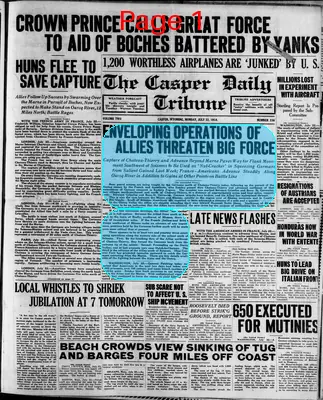
Casper Daily Tribune
Casper, Natrona County, Wyoming
What is this article about?
Allied forces advanced against retreating Germans north of Chateau-Thierry, beyond the Marne, and along the Ourcq River, capturing prisoners and artillery. Enveloping maneuvers threatened German salient southwest of Soissons. Reported July 22, 1918.
Clipping
OCR Quality
Full Text
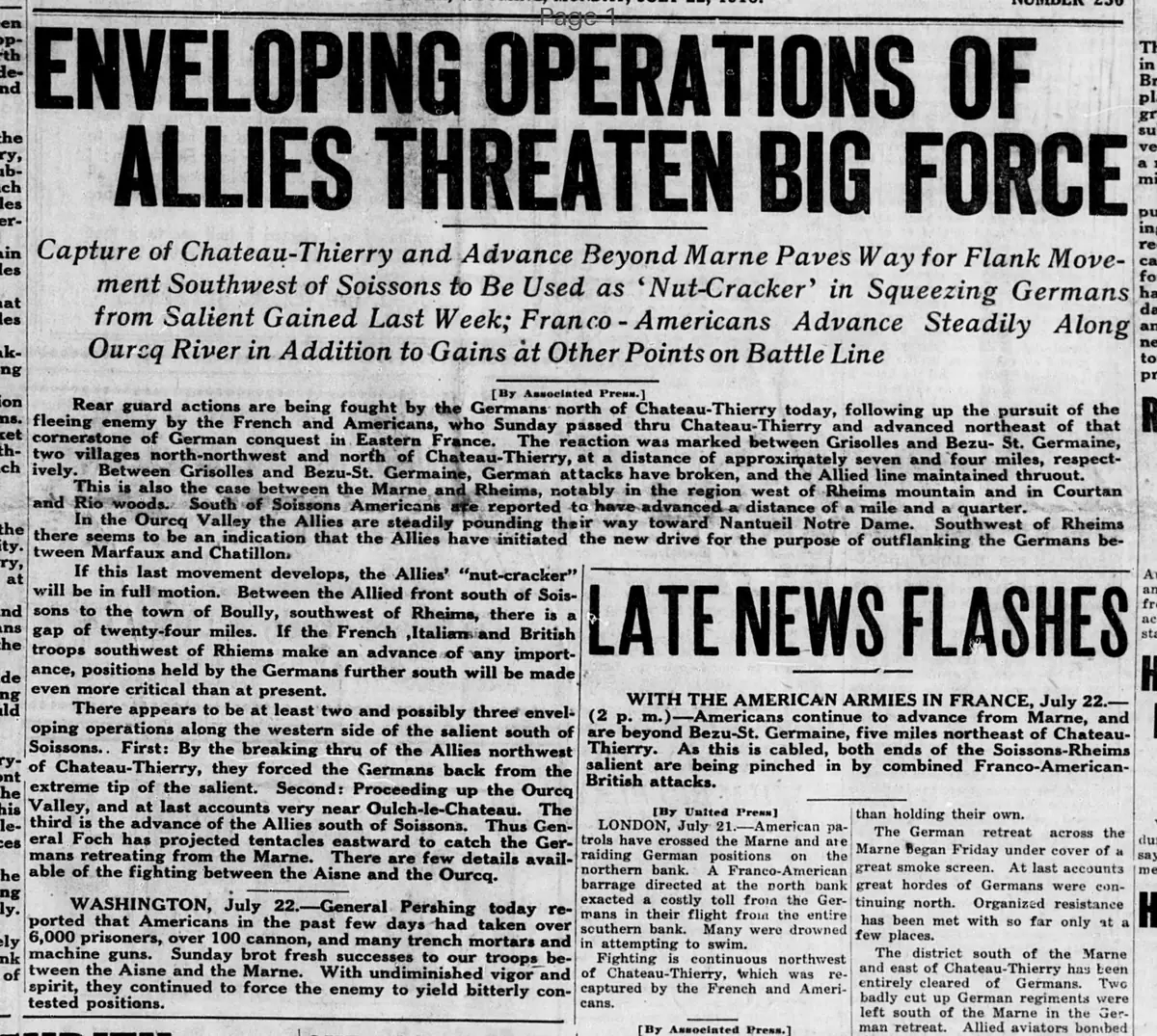
Capture of Chateau-Thierry and Advance Beyond Marne Paves Way for Flank Movement Southwest of Soissons to Be Used as 'Nut-Cracker' in Squeezing Germans from Salient Gained Last Week; Franco-Americans Advance Steadily Along Ourcq River in Addition to Gains at Other Points on Battle Line
[By Associated Press.]
Rear guard actions are being fought by the Germans north of Chateau-Thierry today, following up the pursuit of the fleeing enemy by the French and Americans, who Sunday passed thru Chateau-Thierry and advanced northeast of that cornerstone of German conquest in Eastern France. The reaction was marked between Grisolles and Bezu-St. Germaine, two villages north-northwest and north of Chateau-Thierry, at a distance of approximately seven and four miles, respectively. Between Grisolles and Bezu-St. Germaine, German attacks have broken, and the Allied line maintained thruout.
This is also the case between the Marne and Rheims, notably in the region west of Rheims mountain and in Courtan and Rio woods. South of Soissons Americans are reported to have advanced a distance of a mile and a quarter.
In the Ourcq Valley the Allies are steadily pounding their way toward Nantueil Notre Dame. Southwest of Rheims there seems to be an indication that the Allies have initiated the new drive for the purpose of outflanking the Germans between Marfaux and Chatillon.
If this last movement develops, the Allies' "nut-cracker" will be in full motion. Between the Allied front south of Soissons to the town of Boully, southwest of Rheims, there is a gap of twenty-four miles. If the French, Italians and British troops southwest of Rheims make an advance of any importance, positions held by the Germans further south will be made even more critical than at present.
There appears to be at least two and possibly three enveloping operations along the western side of the salient south of Soissons. First: By the breaking thru of the Allies northwest of Chateau-Thierry, they forced the Germans back from the extreme tip of the salient. Second: Proceeding up the Ourcq Valley, and at last accounts very near Oulch-le-Chateau. The third is the advance of the Allies south of Soissons. Thus General Foch has projected tentacles eastward to catch the Germans retreating from the Marne. There are few details available of the fighting between the Aisne and the Ourcq.
WASHINGTON, July 22. General Pershing today reported that Americans in the past few days had taken over 6,000 prisoners, over 100 cannon, and many trench mortars and machine guns. Sunday brot fresh successes to our troops between the Aisne and the Marne. With undiminished vigor and spirit, they continued to force the enemy to yield bitterly contested positions.
What sub-type of article is it?
What keywords are associated?
What entities or persons were involved?
Where did it happen?
Foreign News Details
Primary Location
Chateau Thierry, France
Event Date
July 22
Key Persons
Outcome
americans took over 6,000 prisoners, over 100 cannon, many trench mortars and machine guns; germans retreating from marne, allied advances forcing flank movements.
Event Details
Allied forces, including French and Americans, pursued retreating Germans north of Chateau-Thierry, advancing beyond Marne and along Ourcq River. Rear guard actions occurred between Grisolles and Bezu-St. Germaine. Advances south of Soissons and southwest of Rheims aimed to envelop German salient. Enveloping operations threatened German positions.