Thank you for visiting SNEWPapers!
Sign up free
Editorial
May 26, 1860
Daily National Democrat
Marysville, Yuba County, California
What is this article about?
The editorial critiques the Sacramento Standard's view that Congress lacks constitutional power over territories, arguing this supports popular sovereignty on slavery and criticizes the Standard's insistence on dictating Democratic party policy against majority non-intervention.
Clipping
OCR Quality
98%
Excellent
Full Text
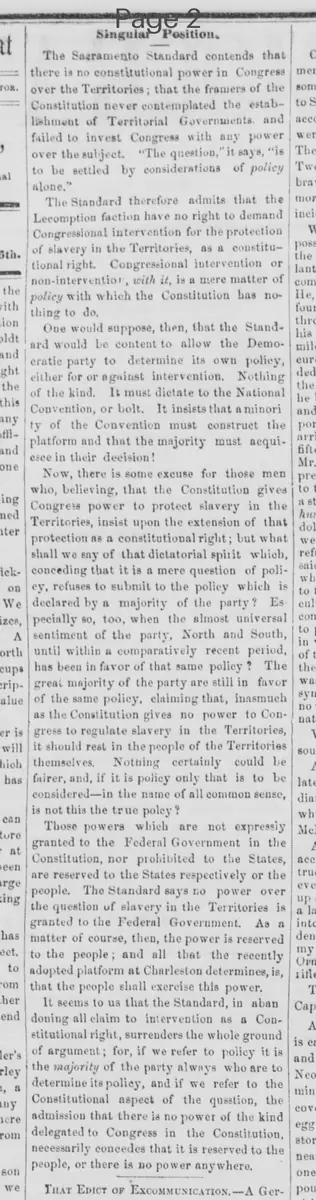
Singular Position,
The Sacramento Standard contends that
there is no constitutional power in Congress
over the Territories; that the framers of the
Constitution never contemplated the estab-
lishment of Territorial Governments and
failed to invest Congress with any power
over the subject. "The question," it says, "is
to be settled by considerations of policy
alone."
The Standard therefore admits that the
Lecompton faction have no right to demand
Congressional intervention for the protection
of slavery in the Territories, as a constitu-
tional right. Congressional intervention or
non-intervention, with it, is a mere matter of
policy with which the Constitution has no-
thing to do.
One would suppose, then, that the Stand-
ard would be content to allow the Demo-
cratic party to determine its own policy
either for or against intervention. Nothing
of the kind. It must dictate to the National
Convention, or bolt. It insists that a minority
of the Convention must construct the
platform and that the majority must acqui-
esce in their decision!
Now, there is some excuse for those men
who, believing that the Constitution gives
Congress power to protect slavery in the
Territories, insist upon the extension of that
protection as a constitutional right; but what
shall we say of that dictatorial spirit which,
conceding that it is a mere question of policy,
refuses to submit to the policy which is
declared by a majority of the party? Es-
pecially so, too, when the almost universal
sentiment of the party, North and South
until within a comparatively recent period
has been in favor of that same policy? The
great majority of the party are still in favor
of the same policy, claiming that, inasmuch
as the Constitution gives no power to Con-
gress to regulate slavery in the Territories
it should rest in the people of the Territories
themselves. Nothing certainly could be
fairer, and, if it is policy only that is to be
considered—in the name of all common sense
is not this the true policy?
Those powers which are not expressly
granted to the Federal Government in the
Constitution, nor prohibited to the States
are reserved to the States respectively or the
people. The Standard says no power over
the question of slavery in the Territories is
granted to the Federal Government. As a
matter of course, then, the power is reserved
to the people; and all that the recently
adopted platform at Charleston determines, is,
that the people shall exercise this power.
It seems to us that the Standard, in aban-
doning all claim to intervention as a Con-
stitutional right, surrenders the whole ground
of argument; for, if we refer to policy it is
the majority of the party always who are to
determine its policy, and if we refer to the
Constitutional aspect of the question, the
admission that there is no power of the kind
del egated to Congress in the Constitution,
necessarily concedes that it is reserved to the
people, or there is no power anywhere.
The Sacramento Standard contends that
there is no constitutional power in Congress
over the Territories; that the framers of the
Constitution never contemplated the estab-
lishment of Territorial Governments and
failed to invest Congress with any power
over the subject. "The question," it says, "is
to be settled by considerations of policy
alone."
The Standard therefore admits that the
Lecompton faction have no right to demand
Congressional intervention for the protection
of slavery in the Territories, as a constitu-
tional right. Congressional intervention or
non-intervention, with it, is a mere matter of
policy with which the Constitution has no-
thing to do.
One would suppose, then, that the Stand-
ard would be content to allow the Demo-
cratic party to determine its own policy
either for or against intervention. Nothing
of the kind. It must dictate to the National
Convention, or bolt. It insists that a minority
of the Convention must construct the
platform and that the majority must acqui-
esce in their decision!
Now, there is some excuse for those men
who, believing that the Constitution gives
Congress power to protect slavery in the
Territories, insist upon the extension of that
protection as a constitutional right; but what
shall we say of that dictatorial spirit which,
conceding that it is a mere question of policy,
refuses to submit to the policy which is
declared by a majority of the party? Es-
pecially so, too, when the almost universal
sentiment of the party, North and South
until within a comparatively recent period
has been in favor of that same policy? The
great majority of the party are still in favor
of the same policy, claiming that, inasmuch
as the Constitution gives no power to Con-
gress to regulate slavery in the Territories
it should rest in the people of the Territories
themselves. Nothing certainly could be
fairer, and, if it is policy only that is to be
considered—in the name of all common sense
is not this the true policy?
Those powers which are not expressly
granted to the Federal Government in the
Constitution, nor prohibited to the States
are reserved to the States respectively or the
people. The Standard says no power over
the question of slavery in the Territories is
granted to the Federal Government. As a
matter of course, then, the power is reserved
to the people; and all that the recently
adopted platform at Charleston determines, is,
that the people shall exercise this power.
It seems to us that the Standard, in aban-
doning all claim to intervention as a Con-
stitutional right, surrenders the whole ground
of argument; for, if we refer to policy it is
the majority of the party always who are to
determine its policy, and if we refer to the
Constitutional aspect of the question, the
admission that there is no power of the kind
del egated to Congress in the Constitution,
necessarily concedes that it is reserved to the
people, or there is no power anywhere.
What sub-type of article is it?
Constitutional
Partisan Politics
What keywords are associated?
Constitutional Power
Territories
Slavery
Popular Sovereignty
Democratic Policy
Lecompton Faction
Congressional Intervention
What entities or persons were involved?
Sacramento Standard
Lecompton Faction
Congress
Democratic Party
National Convention
Framers Of The Constitution
Editorial Details
Primary Topic
Congressional Power Over Territories And Slavery
Stance / Tone
Supportive Of Popular Sovereignty And Critical Of Dictatorial Minority In Democratic Party
Key Figures
Sacramento Standard
Lecompton Faction
Congress
Democratic Party
National Convention
Framers Of The Constitution
Key Arguments
No Constitutional Power In Congress Over Territories
Framers Did Not Contemplate Territorial Governments
Intervention For Slavery Protection Is Policy, Not Constitutional Right
Democratic Party Majority Should Determine Policy On Non Intervention
Power Over Slavery In Territories Reserved To The People
Charleston Platform Affirms People Exercising This Power
Standard's Position Surrenders Argument By Abandoning Constitutional Claim