Thank you for visiting SNEWPapers!
Sign up free
Literary
October 21, 1858
Marshall County Republican
Plymouth, Marshall County, Indiana
What is this article about?
On January 21, 1858, a man stops at an inn overlooking his hometown after 10 years' exile as a pardoned forger. He recounts his jealousy over his brother's fiancée Eunice Manly, a near-murderous blackout by the river, realization of his error, and path to penitence and reconciliation with his brother.
Clipping
OCR Quality
98%
Excellent
Full Text
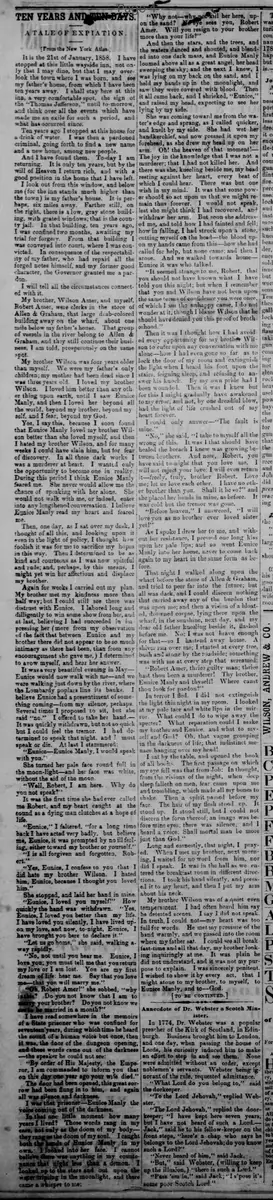
It is the 21st of January, 1858. I have stopped at this little wayside inn, not only that I may dine, but that I may overlook the town where I was born, and see my father's house, from which I have been ten years away. I shall stay here at this inn, a very comfortable spot, the sign of the "Thomas Jefferson," until to-morrow, and think over all the events which have made me an exile for such a period, and what have occurred since.
Ten years ago I stopped at this house for a drink of water. I was then a pardoned criminal, going forth to find a new name and a new home, among new people.
And I have found them. To-day I am returning. It is only ten years, but by the will of Heaven I return rich, and with a good position in the home that I have left.
I look out from this window, and below me (for the inn stands much higher than the town) is my father's house. It is perhaps six miles away. Farther still, on the right, there is a low, gray stone building with grated windows; that is the county jail. In that building, ten years ago, I was confined two months, awaiting my trial for forgery. From that building I was conveyed into court, where I was convicted. In consequence of the respectability of my father, who had repaid all the forged notes himself, and my former good character, the Governor granted me a pardon.
I will tell all the circumstances connected with it.
My brother, Wilson Amer, and myself, Robert Amer, were clerks in the store of Allen & Graham, that large drab-colored building away on the wharf, about one mile below my father's house. That group of vessels in the river belong to Allen & Graham, and they still continue their business, I am told, prosperously on the same spot.
My brother Wilson was four years older than myself. We were my father's only children; my mother had been dead since I was three years old. I loved my brother Wilson. I loved him better than any other thing upon earth, until I saw Eunice Manly, and then I loved her beyond all the world, beyond my brother, beyond myself, and I fear, beyond my God.
Yes, I say this, because I soon found that Eunice Manly loved my brother Wilson better than she loved myself, and then I hated my brother Wilson, and for many weeks I could have slain him, but for fear of discovery. In all these dark works I was a murderer at heart. I wanted only the opportunity to become one in reality.
During this period I think Eunice Manly feared me. She never would allow me the chance of speaking with her alone. She would not walk with me, or indeed, enter into any lengthened conversation. I believe Eunice Manly read my heart and feared me.
Then, one day, as I sat over my desk, I thought of all this, and looking upon it even in the light of policy, I thought how foolish it was for me to sacrifice my hopes in this way. Then I determined to be as kind and courteous as I was now spiteful and rude; and, perhaps, by this means, I might yet win her affections and displace my brother.
Again for weeks I carried out my plan. My brother met my kindness more than half way; but I could still see there was distrust with Eunice. I labored long and diligently to win some show from her, and at last, believing I had succeeded in impressing her (more from my observation of the fact that between Eunice and my brother there did not appear to be so much intimacy as there had been, than from any encouragement she gave me,) I determined to avow myself, and hear her answer.
It was a very beautiful evening in May—Eunice would now walk with me—and we were walking just down by the river, where the Lombardy poplars line its banks. I believe Eunice had a presentiment of something coming—from my silence, perhaps. Several times I proposed to sit, but she said "no." I offered to take her hand.—It was quickly withdrawn, but not so quick but I could feel the tremor. I had determined to speak that night, and I must speak or die. At last I stammered:
"Eunice—Eunice Manly, I would speak with you."
She turned her pale face round full in the moon-light—and her face was white, without the aid of the moon.
"Well, Robert, I am here. Why do you not speak?"
It was the first time she had ever called me Robert, and my heart caught at the sound as a dying man clutches at a hope of life.
"Eunice," I faltered, "for a long time back I have acted very badly, but believe me, Eunice, it was prompted by no ill feeling, either toward my brother or yourself."
"It is all forgiven and forgotten, Robert."
"Yes, Eunice, I confess to you that I did hate my brother Wilson. I hated him, Eunice, because I thought you loved him."
She stopped, and laid her hand in mine.
"Eunice, I loved you myself!" How quickly the hand was withdrawn. "Yes, Eunice, I loved you better than my life. I have loved you silently, I have lived upon my love, and now, to-night, Eunice, I have brought you here to declare it."
"Let us go home," she said, walking away rapidly.
"No, not until you hear me. Eunice, I love you; you must tell me that you return my love or I am lost. You are my first dream of life: hear me. Say that you love me, that you will marry me."
"Oh, Robert Amer!" she sobbed, "why is this? Do you not know that I am to marry your brother? Do you not know we are to be married in a month?"
I have read somewhere in the memoirs of a State prisoner who was confined for seventeen years, during which time he heard the sound of a human voice but once, then it was, the door of the dungeon opening, and these words came out of the darkness—the speaker he could not see:
"By order of His Majesty, the Emperor, I am commanded to inform you that on this day one year ago your wife died."
The door had been opened, this great sorrow had been flung in to him, and again all was silence and darkness.
I was that prisoner—Eunice Manly the voice coming out of the darkness.
In that one little moment how many years I lived? Those words rang in my ears, not only as the doom of my body—they rang as the doom of my soul. I caught both the hands of Eunice Manly in my own. I looked into her face. I cannot believe there was anything in my countenance that night less than a demon. I looked up to the stars and out upon the water rippling in the moonlight, and there came a whisper to me:
"Why not—why not kill her here, upon the sand? My eye sees you, Robert Amer. Will you resign to your brother more than your life?"
And then the stars, and the trees, and the waters danced and shouted, and blended into one dark mass, and Eunice Manly loomed above all as a great angel, her head sweeping the sky; and the next I knew, I was lying on my back on the sand, and I held my hands up in the moonlight, and saw they were covered with blood. Then it all came back, and I shrieked, "Eunice," and raised my head, expecting to see her lying by my side.
She was coming toward me from the water's edge and sprang, as I called quicker, and knelt by my side. She had wet her handkerchief, and now pressed it upon my forehead, as she drew my head up on her arm. Oh! the heaven of that moment! The joy in the knowledge that I was not a murderer; that I had not killed her. And there was she, kneeling beside me, my head resting against her heart, every beat of which I could hear. There was but one wish in my mind. It was that some power should so act upon us that we might remain thus forever. I would not speak, lest she might think I had recovered, and withdraw her arm. But soon she addressed me, and told how I had fainted and fell; how in falling, I had struck upon a stone, cutting myself on the head—the blood upon my hands came from this—how she had called for help, but none came: and then I arose. And we walked towards home—Eunice it was who talked.
"It seemed strange to me, Robert, that you should not have known what I have told you this night; but when I remember that you and Wilson have not been upon the same terms of confidence you were once, of which I am the unhappy cause, I do not wonder at it, though I blame Wilson that he should have denied you this proof of brotherhood."
Then it was I thought how I had avoided every opportunity for my brother Wilson to enter upon any conversation with me alone—how I had even gone so far as to lock the door of my room and extinguish the light when I heard his foot upon the stairs, feigning sleep, and refusing to answer his knock. By my own pride had I been wounded. Then it was I knew but for this I might gradually have awakened to my error, and not, by one dreadful blow, had the light of life crushed out of my heart forever.
I could only answer—“The fault is mine.”
"No," she said, "I take to myself all the wrong of this. It was I that should have healed the breach I knew was growing between brothers. And now, Robert, you have said to-night that you love me. I will not reject your love: I will even return it—freely, truly, brother Robert. Love me; let us love each other. I have no other brother than you. Shall it be so?" and she placed her hands in mine, as before. It was cold but the tremor was gone.
"Before heaven," I answered, "I will love you as no brother ever loved sister yet!"
As I spoke I drew her to me, and without her resistance, I pressed one long kiss upon her pale lips; and so went Eunice Manly into her home, never to come back again to my heart in the same form as before.
That night I walked along upon the wharf before the store of Allen & Graham, and tried to peer far into the future; but all was dark, and I could discern nothing that carried away any of the burden that was upon me; and then a vision of a bloated, drowned corpse, lying there upon the wharf, in the sunshine, next day, and my dear old father kneeling beside it, flashed before me. No: I was not brave enough for that—so I hastened away home. A shiver ran over me; I started at every tree, bush and stone by the roadside; something was with me at every step that screamed:
"Robert Amer, thrice guilty man; thrice hast thou been a murderer! Thy brother, Eunice Manly and thyself! Where canst thou look for pardon?"
In terror I fled. I did not extinguish the light this night in my room. I looked at my pale face and white lips in the mirror. What could I do to wipe away the specter? What reparation could I make my brother and Eunice, and what to myself and God? Oh, that vague grouping in the darkness of life: that indistinct menace hanging over my head!
I sat by the table, and opened the book of all books. The first passage on which my eye fell was that from Job: In thought, from the visions of the night, when deep sleep falleth on men, fear came upon me and trembling, which made all my bones to shake. Then a spirit passed before my face. The hair of my flesh stood up. It stood still, but I could not discern the form thereof; an image was before mine eyes: there was silence; and I heard a voice: Shall mortal man be more just than God.
Long and earnestly, that night, I prayed. When I met my brother, next morning, I waited for no word from him, nor did I speak. It was in the hall as we entered the breakfast room in different directions. I took his hand silently, and pressed it to my heart, and then I put my arm about his neck.
My brother Wilson was of a quiet even temperament. I had often heard him say he detested scenes. I say I did not speak. In truth, I could not—my heart was too full for words. He met my pressure of the hand warmly, and we passed into the room where my father sat. I could see all breakfast-time and all that day, my brother looking inquiringly at me. It was plain he did not understand, and it was not my purpose to explain. I was sincerely penitent. I wished to show it by every act, that I might atone to my brother, to myself, to Eunice Manly, and to—God.
What sub-type of article is it?
Prose Fiction
What themes does it cover?
Love Romance
Moral Virtue
Friendship
What keywords are associated?
Jealousy
Forgery
Confession
Redemption
Brotherly Love
Romantic Rejection
Penitence
Literary Details
Key Lines
"Eunice, I Loved You Myself!" How Quickly The Hand Was Withdrawn. "Yes, Eunice, I Loved You Better Than My Life. I Have Loved You Silently, I Have Lived Upon My Love, And Now, To Night, Eunice, I Have Brought You Here To Declare It."
"Oh, Robert Amer!" She Sobbed, "Why Is This? Do You Not Know That I Am To Marry Your Brother? Do You Not Know We Are To Be Married In A Month?"
"Why Not—Why Not Kill Her Here, Upon The Sand? My Eye Sees You, Robert Amer. Will You Resign To Your Brother More Than Your Life?"
"Before Heaven," I Answered, "I Will Love You As No Brother Ever Loved Sister Yet!"
"Robert Amer, Thrice Guilty Man; Thrice Hast Thou Been A Murderer! Thy Brother, Eunice Manly And Thyself! Where Canst Thou Look For Pardon?"