Thank you for visiting SNEWPapers!
Sign up free
The New Hampshire Gazette And General Advertiser
Portsmouth, Exeter, Rockingham County, New Hampshire
What is this article about?
Detailed account of daily slave discipline on sugar plantations: from 4am bell to midnight, tasks include field work, grass collection for cattle, punishments with lashes for shortages or tardiness, overseer enforcement.
Merged-components note: Continuation of the foreign news article from the Jamaica Gazette, extending the description of post-hurricane conditions to include details on sugar plantation discipline.
Clippings
1 of 2
OCR Quality
Full Text
This is Event 2 of 2. The full text below covers all events in this component.
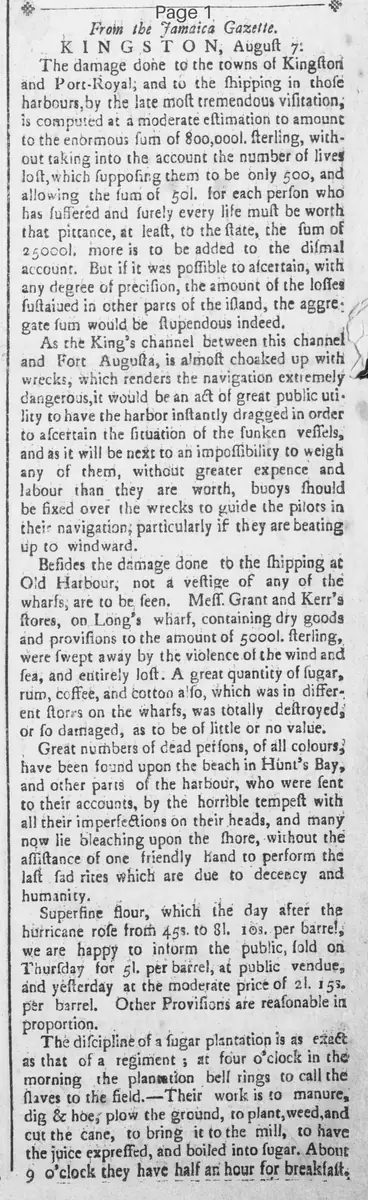
KINGSTON: August 7:
The damage done to the towns of Kingston
and Port-Royal; and to the shipping in those
harbours, by the late most tremendous visitation,
is computed at a moderate estimation to amount
to the enormous sum of 800,000l. sterling, without
taking into the account the number of lives
lost, which supposing them to be only 500, and
allowing the sum of 50l. for each person who
has suffered and surely every life must be worth
that pittance, at least, to the state, the sum of
25,000l. more is to be added to the dismal
account. But if it was possible to ascertain, with
any degree of precision, the amount of the losses
sustained in other parts of the island, the aggre-
gate sum would be stupendous indeed.
As the King's channel between this channel
and Fort Augusta, is almost choked up with
wrecks, which renders the navigation extremely
dangerous, it would be an act of great public uti-
lity to have the harbor instantly dragged in order
to ascertain the situation of the sunken vessels.
and as it will be next to an impossibility to weigh
any of them, without greater expense and
labour than they are worth, buoys should
be fixed over the wrecks to guide the pilots in
their navigation; particularly if they are beating
up to windward.
Besides the damage done to the shipping at
Old Harbour; not a vestige of any of the
wharfs, are to be seen. Messrs. Grant and Kerr's
stores, on Long's wharf, containing dry goods
and provisions to the amount of 5000l. sterling,
were swept away by the violence of the wind and
sea, and entirely lost. A great quantity of sugar,
rum, coffee, and cotton also, which was in different
stores on the wharfs, was totally destroyed
or so damaged, as to be of little or no value:
Great numbers of dead persons, of all colours,
have been found upon the beach in Hunt's Bay,
and other parts of the harbour, who were sent
to their accounts, by the horrible tempest with
all their imperfections on their heads, and many
now lie bleaching upon the shore, without the
assistance of one friendly hand to perform the
last sad rites which are due to decency and
humanity.
Superfine flour, which the day after the
hurricane rose from 45s. to 8l. 10s. per barrel.
we are happy to inform the public, sold on
Thursday for 6l. per barrel, at public vendue,
and yesterday at the moderate price of 2l. 15s.
per barrel. Other Provisions are reasonable in
proportion.
The discipline of a sugar plantation is as exact
as that of a regiment; at four o'clock in the
morning the plantation bell rings to call the
slaves to the field. Their work is to manure,
dig & hoe; plow the ground, to plant, weed, and
cut the cane, to bring it to the mill, to have
the juice expressed, and boiled into sugar. About
9 o'clock they have half an hour for breakfast.
which they take in the field: Again they fall to work, and, according to the custom of the plantation, continue until eleven o'clock, or noon; the bell then rings, and the slaves are dispersed in the neighbourhood; to pick up about the fences, in the mountains, and fallow or waste grounds, natural grass and weeds for the horses and cattle. The time allotted for this branch of work, and preparation of dinner varies from an hour and an half to near three hours. In collecting pile by pile their little bundles of grass, the slaves of the lowland plantations, frequently burnt up by the sun, must wander in their neighbours grounds perhaps more than two miles from home. In their return often some lazy fellow, of the intermediate plantation, with a view of saving himself the trouble of picking his own grass, seizes on them, and pretends to insist on carrying them to his master, for picking grass or being found in his grounds; a crime that forfeits the bundle, and subjects the offender to twenty lashes of a long cart whip, of twisted leathern thongs. The wretch, rather than be carried to judgment in another man's plantation, is fain to escape with the loss of his bundle, and often to put up quietly with a good drubbing from the robber into the bargain. The hour of delivering in his grass, and renewing his task, approaches, while hunger importunately solicits him to remember its call; but he must renew the irksome toil, and search some green, shady, unfrequented spot, from which to repair his loss.
At one, or in some plantations, at 2 o'clock, the bell summons them to deliver in the tale of their grass, and assemble to their field work. If the overseer thinks their bundles too small, or if they come too late with them, they are punished with a number of stripes from four to ten. Some masters, under a fit of carefulness for their cattle, have gone as far as fifty stripes, which effectually disables the culprit for weeks. If a slave has no grass to deliver in, he keeps away out of fear, skulks about in the mountains, and is absent from his work often for months: in aggravation of his crime, which when he is caught, he is made to remember.
About half an hour before sun set, they may be found scattered again over the land, like the Israelites in Egypt, to cull, blade by blade, from among the weeds, their scanty parcels of grass. About seven o'clock in the evening, or later, according to the season of the year, when the overseer can find leisure, they are called over by list, to deliver in their second bundles of grass; and the same punishment as at noon, is inflicted on the delinquents. They then separate, to pick up, in their way to their huts (if they have not done it, as they generally do, while gathering grass) a little bush wood, or dry cow dung, to prepare some simple mess for supper, and tomorrow's breakfast. This employs them till near midnight, and then they go to sleep, 'till the bell calls them in the morning.
What sub-type of article is it?
What keywords are associated?
Where did it happen?
Foreign News Details
Primary Location
Jamaica
Event Details
Detailed account of daily slave discipline on sugar plantations: from 4am bell to midnight, tasks include field work, grass collection for cattle, punishments with lashes for shortages or tardiness, overseer enforcement.