Thank you for visiting SNEWPapers!
Sign up free
Literary
September 5, 1827
Literary Cadet And Rhode Island Statesman
Providence, Providence County, Rhode Island
What is this article about?
In this moral tale, innocent Rose Melroy is rescued from a drunkard by charming Lucius Dennison, who seduces and impregnates her before abandoning her in Paris. Heartbroken, Rose dies. Her father, seeking revenge, travels to Paris, duels Dennison, and is killed. Tormented by guilt, Dennison commits suicide.
Clipping
OCR Quality
95%
Excellent
Full Text
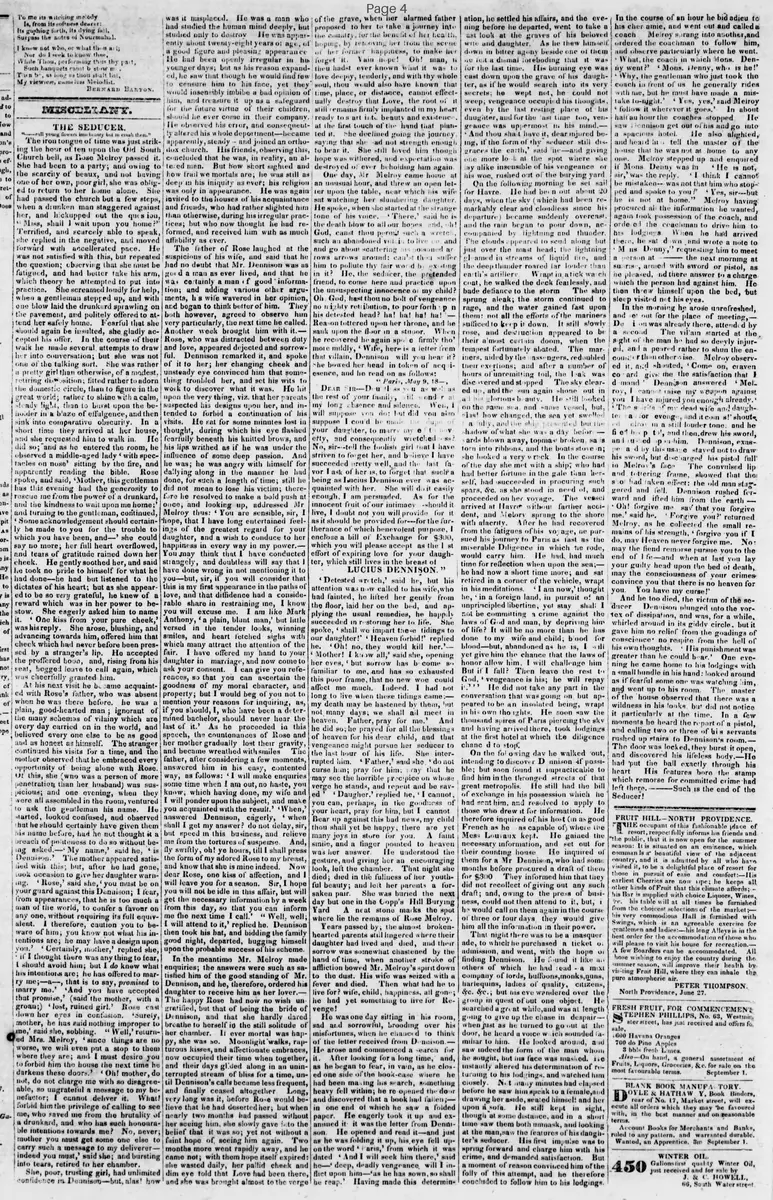
MISCELLANY.
THE SEDUCER.
"--call young flowers into beauty but to crush them."
The iron tongue of time was just striking the hour of ten upon the Old South Church bell, as Rose Melroy passed it. She had been to a party; and owing to the scarcity of beaux, and not having one of her own, poor girl, she was obliged to return to her home alone. She had passed the church but a few steps, when a drunken man staggered against her, and hiccupped out the question, "Miss, shall I wait upon you home?"
Terrified, and scarcely able to speak, she replied in the negative, and moved forward with accelerated pace. He was not satisfied with this, but repeated the question; observing that she must be fatigued, and had better take his arm, which theory he attempted to put into practice. She screamed loudly for help, when a gentleman stepped up, and with one blow laid the drunkard sprawling on the pavement, and politely offered to attend her safely home. Fearful that she should again be insulted, she gladly accepted his offer. In the course of their walk he made several attempts to draw her into conversation; but she was not one of the talking sort. She was rather a pretty girl than otherwise, of a modest, retiring disposition; fitted rather to adorn the domestic circle, than to figure in the great world; rather to shine with a calm, steady light, than to burst upon the beholder in a blaze of effulgence, and then sink into comparative obscurity. In a short time they arrived at her house, and she requested him to walk in. He did so; and as he entered the room, he observed a middle-aged lady 'with spectacles on nose' sitting by the fire, and apparently reading the bible. Rose spoke, and said, 'Mother, this gentleman has this evening had the generosity to rescue me from the power of a drunkard, and the kindness to wait upon me home;' and turning to the gentleman, continued, 'Some acknowledgement should certainly be made to you for the trouble to which you have been,' and-- she could say no more; her full heart overflowed, and tears of gratitude rained down her cheek. He gently soothed her, and said he took no pride to himself for what he had done--he had but listened to the dictates of his heart; but as she appeared to be so very grateful, he knew of a reward which was in her power to bestow. She eagerly asked him to name it. 'One kiss from your pure cheek,' was his reply. She arose, blushing, and advancing towards him, offered him that cheek which had never before been pressed by a stranger's lip. He accepted the proffered boon, and, rising from his seat, begged leave to call again, which was cheerfully granted him.
At his next visit he became acquainted with Rose's father, who was absent when he was there before. He was a plain, good-hearted man; ignorant of the many schemes of villainy which are every day carried on in the world, and believed every one else to be as good and as honest as himself. The stranger continued his visits for a time, and the mother observed that he embraced every opportunity of being alone with Rose. At this, she (who was a person of more penetration than her husband) was suspicious; and one evening, when they were all assembled in the room, ventured to ask the gentleman his name. He started, looked confused, and observed that he should certainly have given them his name before, had he not thought it a breach of politeness to do so without being asked.--'My name,' said he, 'is Dennison.' The mother appeared satisfied with this; but, after he had gone, took occasion to give her daughter warning. 'Rose,' said she, 'you must be on your guard against this Dennison; I fear, from appearances, that he is too much a man of the world, to confer a favour on any one, without requiring its full equivalent. I therefore, caution you to beware of him; you know not what his intentions are; he may have a design upon you.' 'Certainly, mother,' replied she, 'if I thought there was any thing to fear, I should avoid him; but I do know what his intentions are; he has offered to marry me;--ah, that is to say, promised to marry me.' 'And you have accepted that promise,' (said the mother, with a groan;) 'lost, ruined girl.' Rose cast down her eyes in confusion. 'Surely, mother, he has said nothing improper to me,' said she, sobbing. 'Well,' returned Mrs. Melroy, 'since things are no worse, we will even put a stop to them where they are; and I must desire you to forbid him the house the next time he darkens these doors.' 'Oh! mother, do not, do not charge me with so disagreeable, so ungrateful a message to my benefactor; I cannot deliver it. What! forbid him the privilege of calling to see me, who saved me from the brutality of a drunkard, and who has such honourable intentions towards me? No, never; mother you must get some one else to carry such a message to my deliverer--indeed you must,' said she; and bursting into tears, retired to her chamber.
She, poor, trusting girl, had unlimited confidence in Dennison--but, alas! how was it misplaced. He was a man who had studied the human mind deeply, but studied only to destroy. He was apparently about twenty-eight years of age, of a good figure and pleasing appearance. He had been openly irregular in his younger days; but as his reason expanded, he saw that though he would find few to censure him to his face, yet they would insensibly imbibe a bad opinion of him, and treasure it up as a safeguard for the future virtue of their children, should he ever come in their company. He observed his error, and consequently altered his whole deportment--became apparently steady--and joined an orthodox church. His friends, observing this, concluded that he was, in reality, an altered man. But how short sighted and how frail we mortals are; he was still as deep in his iniquity as ever; his religion was only in appearance. He was again invited to the houses of his acquaintance and friends, who had rather slighted him than otherwise, during his irregular practices; but who now thought he had reformed, and received him with as much affability as ever.
The father of Rose laughed at the suspicions of his wife, and said that he had no doubt that Mr. Dennison was as good a man as ever lived, and that he was certainly a man of good information; and adding various other arguments, his wife wavered in her opinion, and began to think better of him. They both however, agreed to observe him very particularly, the next time he called.
Another week brought him with it. Rose, who was distracted between duty and love, appeared dejected and sorrowful. Dennison remarked it, and spoke of it to her; her changing cheek and unsteady eye convinced him that something troubled her, and set his wits to work to discover what it was. He hit upon the very thing, viz. that her parents suspected his designs upon her, and intended to forbid a continuation of his visits. He sat for some minutes lost in thought, during which his eye flashed fearfully beneath his knitted brows, and his lips writhed as if he was under the influence of some deep passion. And he was; he was angry with himself for dallying along in the manner he had done, for such a length of time; still he did not mean to lose his victim; therefore he resolved to make a bold push at once; and looking up, addressed Mr. Melroy thus: 'You are sensible, sir, I hope, that I have long entertained feelings of the greatest regard for your daughter, and a wish to conduce to her happiness in every way in my power. You may think that I have conducted strangely, and doubtless will say that I have done wrong in not mentioning it to you--but, sir, if you will consider that this is my first appearance in the paths of love, and that diffidence had a considerable share in restraining me, I know you will excuse me. I am like Mark Anthony, 'a plain, blunt man,' but little versed in the tender looks, winning smiles, and heart-fetched sighs with which many attract the attention of the fair. I have offered my hand to your daughter in marriage, and now come to ask your consent. I can give you references, so that you can ascertain the goodness of my moral character, and property; but I would beg of you not to mention your reasons for inquiring, as, if you should, I, who have been a determined bachelor, should never hear the last of it.' As he proceeded in this speech, the countenances of Rose and her mother gradually lost their gravity, and became wreathed with smiles. The father, after considering a few moments, answered him in his easy, contented way, as follows: 'I will make enquiries some time when I am out, no haste, you know; which having done, my wife and I will ponder upon the subject, and make you acquainted with the result.' 'When,' answered Dennison, eagerly, 'when shall I get my answer? do not delay, sir, but speed in this business, and relieve me from the tortures of suspense. And, fly swiftly, oh! ye hours, till I shall press the form of my adored Rose to my breast, and know that she is mine indeed. Now dear Rose, one kiss of affection, and I will leave you for a season. Sir, I hope you will not be idle in this affair, but will get the necessary information by a week from this day, so that you can inform me the next time I call.' 'Well, well; I will attend to it,' replied he. Dennison then took his hat, and bidding the family good night, departed, hugging himself upon the probable success of his scheme.
In the meantime Mr. Melroy made enquiries; the answers were such as satisfied him of the good standing of Mr. Dennison, and he, therefore, ordered his daughter to receive him as her lover. The happy Rose had now no wish ungratified, but that of being the bride of Dennison, and that she hardly dared breathe to herself in the still solitude of her chamber. If ever mortal was happy, she was so. Moonlight walks, rapturous kisses, and affectionate embraces, now occupied their time when together, and their days glided along in an uninterrupted stream of bliss for a time, until Dennison's calls became less frequent, and finally ceased altogether. Long, very long was it, before Rose would believe that he had deserted her; but when nearly two months had passed without her seeing him, she slowly gave in to the belief that it was so; yet not without a faint hope of seeing him again. Two months more went rapidly away, and he came not; with them hope itself expired: she wasted daily, her pallid cheek and dim eye told that Love had been there, and she was brought almost to the verge of the grave, when her alarmed father proposed to her to take a journey into the country, for the benefit of her health, hoping, by removing her from the scene of her former happiness, to make her forget it. Vain hope! Oh! man, if thou hadst ever known what it was to love deeply, tenderly, and with thy whole soul, thou would also have known that time, place, or distance, cannot effectually destroy that Love, the root of which still remains firmly implanted in my heart ready to start into beauty and existence at the first touch of the hand that planted it. She declined going the journey, saying that she had not strength enough to bear it. She still loved him though hope was withered, and expectation was destroyed of ever beholding him again.
One day, Mr. Melroy came home at an unusual hour, and threw an open letter upon the table, near which his wife sat watching her slumbering daughter. He spoke, when she started at the strange tone of his voice. 'There,' said he 'is the death blow to all our hopes and, oh! God, canst thou permit such a wretch, such an abandoned villain to live on and go about scattering his poisoned arrows around: can'st thou suffer him to pollute thy fair world by existing in it? He, the seducer, the pretended friend, to come here and practice upon the unsuspecting innocence of my child? Oh, God, hast thou no bolt of vengeance no mighty retribution, to pour forth upon his detested head? ha! ha! ha! ha!'
Reason tottered upon her throne, and he sank upon the floor in a stupor. When he recovered he again spoke firmly though more mildly, 'Wife, here is a letter from that villain, Dennison will you hear it?'--he bowed her head in token of acquiescence, and he read on as follows:
"Paris, May 9, 18--,
DEAR SIR--Doubtless you wonder at my long absence and silence. Well, I will suppose you do: but did you also suppose I could be made the dupe of your daughter, to marry my estate to her pretty, and consequently wretched self? No, sir---tell the foolish girl that I have striven to forget her, and believe I have succeeded pretty well, and the last favour I ask of her is, to forget that such a being as Lucius Dennison ever was acquainted with her. She will do it easily enough, I am persuaded. As for the innocent fruit of our intimacy -should it live, I doubt not you will provide for it as it should be provided for---for the furtherance of which benevolent purpose, I enclose a bill of Exchange for $300, which you will please accept as the last effort of expiring love for your daughter, which still lives in the breast of
LUCIUS DENNISON. "
'Detested wretch,' said he, but his attention was now called to his wife, who had fainted, he lifted her gently from the floor, laid her on the bed, and applying the usual remedies, he happily succeeded in restoring her to life. She spoke, 'shall we impart these tidings to our daughter!' 'Heaven forbid!' replied he. 'Oh! no, they would kill her.' 'Mother! I know all,' said she, opening her eyes, 'but sorrow has become so familiar to me, and has so exhausted this poor frame, that no new woe could affect me much. Indeed. I had not long to live when these tidings came:-- my death may be hastened by them, but not many days; we shall all meet in heaven. Father, pray for me.' And he did so; he prayed for all the blessings of heaven for his dear child, and that vengeance might pursue her seducer to the last hour of his life. She interrupted him. 'Father,' said she. 'do not curse him; pray for him; pray that he may see the horrible precipice on whose verge he stands, and repent and be saved.' 'Daughter,' replied he, 'I cannot, you can, perhaps, in the goodness of your heart, pray for him, but I cannot. Bear up against this bad news, my child thou shall yet be happy, there are yet many joys in store for you.' A faint smile, and a finger pointed to heaven was her answer. He understood the gesture, and giving her an encouraging look, left the chamber. That night she died; died in the fullness of her youthful beauty; and left her parents a forsaken pair. She was buried the next day but one in the Copp's Hill Burying Yard. A neat stone marks the spot where lie the remains of Rose Melroy.
Years passed by; the almost broken-hearted parents still lingered where their daughter had lived and died, and their sorrow was somewhat chastened by the hand of time, when another stroke of affliction bowed Mr. Melroy's spirit down to the dust. His wife was seized with a fever and died. Then what had he to live for? wife, child, happiness, all gone; he had yet something to live for--Revenge!
He was one day sitting in his room sad and sorrowful, brooding over his misfortunes, when he chanced to think of the letter received from Dennison. He arose and commenced a search for it. After looking for a long time, and, as he began to fear, in vain, as he closed one side of the book-case where he had been making his search, something heavy fell within; he re-opened the door and discovered that a book had fallen;-- in one end of which he saw a folded paper. He eagerly took it up and examined it: it was the letter from Dennison. He opened and read it--and just as he was folding it up, his eye fell upon the word 'Paris,' from which it was dated. 'And I will seek him there,' said he--'deep, deadly vengeance will I inflict upon him--'as he has sown, so shall he reap.' Having made this determination, he settled his affairs, and the evening before he departed, went to take a last look at the graves of his beloved wife and daughter. As he threw himself down in bitter agony beside one of them he felt a dismal foreboding that it was for the last time. His burning eye was cast down upon the grave of his daughter, as if he would search into its very secrets; he wept not, he could not weep; vengeance occupied his thoughts, even by the last resting place of his daughter, and for the last time too, vengeance was uppermost in his mind.--
'And thou shalt have it, dear injured being, if the form of thy seducer still disgraces the earth,' said he--and giving one more look at the spot where she lay alike insensible of his vengeance or his woe, rushed out of the burying yard.
On the following morning he set sail for Havre. He had been out about 20 days, when the sky (which had been remarkably clear and cloudless since his departure) became suddenly overcast, and the rain began to pour down, accompanied by lightning and thunder. The clouds appeared to scud along but just over the mast head; the lightning gleamed in streams of liquid fire, and the deep thunder roared far louder than earth's artillery. Wrapped in a thick watch coat, he walked the deck fearlessly, and bade defiance to the storm. The ship sprung a leak; the storm continued to rage, and the water gained fast upon them: not all the efforts of the mariners sufficed to keep it down. It still slowly rose, and destruction appeared to be their almost certain doom, when the tempest fortunately abated. The mariners, aided by the passengers, redoubled their exertions; and after a number of hours of unremitting toil, the leak was discovered and stopped. The sky cleared up, and the sun again shone out in all his glorious beauty. He still looked on the same sea, and same vessel, but, alas! how changed, the sea yet swelled turbidly, and the ship presented but the shadow of what she was a day before--yards blown away, topmast broken, sails torn into ribbons, and the boats stove in; she looked a very wreck. In the course of the day she met with a ship; who had had better fortune in the gale than herself, had succeeded in procuring such spars, &c. as she stood in need of, and proceeded on her voyage. The vessel arrived at Havre without farther accident, and Melroy sprang to the shore with alacrity. After he had recovered from the fatigues of his voyage, he pursued his journey to Paris as fast as the miserable Diligence in which he rode, would carry him. He had had much time for reflection when upon the sea;-- he had now a short time more; and sat retired in a corner of the vehicle, wrapt in his meditations. 'I am now,' thought he, 'in a foreign land, in pursuit of an unprincipled libertine, yet stay shall I not be committing a crime against the laws of God and man, by depriving him of life? It will be no more than he has done to my wife and child; blood for blood--but, abandoned as he is. I'll yet give him the chance that the laws of honor allow him, I will challenge him. But if I fall? Then leave the rest to God, 'vengeance is his; he will repay.'
He did not take any part in the conversation that was going on, but appeared to be an isolated being, wrapt in his own thoughts. He soon saw the thousand spires of Paris piercing the sky and having arrived there, took lodgings at the first hotel at which the diligence chanced to stop.
On the following day he walked out, intending to discover Dennison--if possible; but soon found it impracticable to find him in the thronged streets of that great metropolis. He still had the bill of exchange in his possession which he had sent him, and resolved to apply to those who drew it for information. He therefore inquired of his host (in as good French as he was capable of) where the Messrs. Louvaux kept. He gained the necessary information, and set out for their counting house. He inquired of them for a Mr. Dennison, who had some months before procured a draft of them for $300. They informed him that they did not recollect of giving out any such draft; and, owing to the press of business, could not then attend to it. but if he would call on them again in the course of three or four days they would give him all the information in their power.
That night there was to be a masquerade, to which he purchased a ticket of admission, and went, with the hope of finding Dennison. He found it like all others of which he had read--a mixed company of lords, buffoons, monks, nuns, harlequins, ladies of quality, citizens, &c. &c.; but his eye wandered over the group in quest of but one object. He searched a great while, and was at length going to give up the chase in despair--- when just as he turned to go out at the door, he heard a voice which sounded familiar to him. He looked around, and saw indeed the form of the man whom he sought, but his face was masked. He instantly altered his determination of returning to his lodgings, and watched him closely. Not many minutes had elapsed before he saw him speak to a female, and drawing her aside, seated himself and her upon a sofa. He still kept in sight, though at some distance, and in a short time saw them both unmask, and looking at the man, saw the features of his daughter's seducer. His first impulse was to spring forward and charge him with his crime, and demand satisfaction. But a moment of reason convinced him of the folly of this attempt, and he therefore concluded to follow him to his lodgings.
In the course of an hour he bid adieu to his cher amie, and went out and called a coach. Melroy sprang into another, and ordered the coachman to follow him, and observe particularly where he went. 'What, the coach in which Mons. Dennison went?' 'Mons. Dennison, who is he!' 'Why, the gentleman who just took the coach in front of us he generally rides with me, but he must have made a mistake to-night.' 'Yes, yes,' said Melroy 'follow it wherever it goes.' In about half an hour the coaches stopped. He saw Dennison get out of his and go into a spacious hotel. He also alighted, and heard him, tell the master of the house that he was not at home to any one. Melroy stepped up and enquired if Mons. Denny was in. 'He is not, sir,' was the reply. 'I think I cannot be mistaken---was not that him who stopped and spoke to you?' 'Yes, sir---but he is not at home.' Melroy having procured all the information he wanted, again took possession of the coach, and ordered the coachman to drive him to his lodgings. When he had arrived there, he sat down and wrote a note to 'Mons. Denny,' requesting him to meet a person at the Tuileries, the next morning at sunrise, armed with sword or pistol, as he pleased, and there answer to a charge which the person had against him. He then threw himself upon the bed, but sleep visited not his eyes.
In the morning he arose unrefreshed, and set out for the place of meeting,-- Dennison was already there, attended by a second. The villain started at the sight of the man he had so deeply injured, and appeared rather to shun the encounter than otherwise. Melroy observed it, and shouted, 'Come on, craven coward give me the satisfaction that I demand' Dennison answered 'Melroy, I cannot raise my weapon against you I have injured you enough already.' 'The spirits of my dead wife and daughter cry for vengeance, and it comes!' shouted he in a still louder tone: and he fired his pistol, and then drew his sword, and rushed on him. Dennison, exasperated by this usage staved not to draw his sword, but discharged his pistol full in Melroy's face. The convulsed lip and tottering frame, showed that the shot had taken effect: the old man staggered and fell. Dennison rushed forward and lifted him from the earth-- 'Oh! forgive me say that you forgive me.' said he. 'Forgive you?' returned Melroy, as he collected the small remains of his strength, 'forgive you if I do, may Heaven never forgive me. No: may the fiend remorse pursue you to the end of life--and when at last you lay your guilty head upon the bed of death, may the consciousness of your crimes convince you that there is no heaven for you. You have my curse!'
And he too died, the victim of the seducer. Dennison plunged into the vortex of dissipation, and was, for a while, whirled around in its giddy circle. but it gave him no relief from the goadings of conscience: no respite from the hell of his own thoughts. His punishment was greater than he could bear. One evening he came home to his lodgings with a small bundle in his hand: looked around as if fearful some one was watching him, and went up to his room. The master of the house observed that there was a wildness in his looks. but did not notice it particularly at the time. In a few moments he heard the report of a pistol, and calling two or three of his servants rushed up stairs to Dennison's room.-- The door was locked, they burst it open, and discovered his lifeless body.--He had put the ball exactly through his heart. His features bore the stamp which remorse for committed crime had left there.--
Such is the end of the Seducer!
THE SEDUCER.
"--call young flowers into beauty but to crush them."
The iron tongue of time was just striking the hour of ten upon the Old South Church bell, as Rose Melroy passed it. She had been to a party; and owing to the scarcity of beaux, and not having one of her own, poor girl, she was obliged to return to her home alone. She had passed the church but a few steps, when a drunken man staggered against her, and hiccupped out the question, "Miss, shall I wait upon you home?"
Terrified, and scarcely able to speak, she replied in the negative, and moved forward with accelerated pace. He was not satisfied with this, but repeated the question; observing that she must be fatigued, and had better take his arm, which theory he attempted to put into practice. She screamed loudly for help, when a gentleman stepped up, and with one blow laid the drunkard sprawling on the pavement, and politely offered to attend her safely home. Fearful that she should again be insulted, she gladly accepted his offer. In the course of their walk he made several attempts to draw her into conversation; but she was not one of the talking sort. She was rather a pretty girl than otherwise, of a modest, retiring disposition; fitted rather to adorn the domestic circle, than to figure in the great world; rather to shine with a calm, steady light, than to burst upon the beholder in a blaze of effulgence, and then sink into comparative obscurity. In a short time they arrived at her house, and she requested him to walk in. He did so; and as he entered the room, he observed a middle-aged lady 'with spectacles on nose' sitting by the fire, and apparently reading the bible. Rose spoke, and said, 'Mother, this gentleman has this evening had the generosity to rescue me from the power of a drunkard, and the kindness to wait upon me home;' and turning to the gentleman, continued, 'Some acknowledgement should certainly be made to you for the trouble to which you have been,' and-- she could say no more; her full heart overflowed, and tears of gratitude rained down her cheek. He gently soothed her, and said he took no pride to himself for what he had done--he had but listened to the dictates of his heart; but as she appeared to be so very grateful, he knew of a reward which was in her power to bestow. She eagerly asked him to name it. 'One kiss from your pure cheek,' was his reply. She arose, blushing, and advancing towards him, offered him that cheek which had never before been pressed by a stranger's lip. He accepted the proffered boon, and, rising from his seat, begged leave to call again, which was cheerfully granted him.
At his next visit he became acquainted with Rose's father, who was absent when he was there before. He was a plain, good-hearted man; ignorant of the many schemes of villainy which are every day carried on in the world, and believed every one else to be as good and as honest as himself. The stranger continued his visits for a time, and the mother observed that he embraced every opportunity of being alone with Rose. At this, she (who was a person of more penetration than her husband) was suspicious; and one evening, when they were all assembled in the room, ventured to ask the gentleman his name. He started, looked confused, and observed that he should certainly have given them his name before, had he not thought it a breach of politeness to do so without being asked.--'My name,' said he, 'is Dennison.' The mother appeared satisfied with this; but, after he had gone, took occasion to give her daughter warning. 'Rose,' said she, 'you must be on your guard against this Dennison; I fear, from appearances, that he is too much a man of the world, to confer a favour on any one, without requiring its full equivalent. I therefore, caution you to beware of him; you know not what his intentions are; he may have a design upon you.' 'Certainly, mother,' replied she, 'if I thought there was any thing to fear, I should avoid him; but I do know what his intentions are; he has offered to marry me;--ah, that is to say, promised to marry me.' 'And you have accepted that promise,' (said the mother, with a groan;) 'lost, ruined girl.' Rose cast down her eyes in confusion. 'Surely, mother, he has said nothing improper to me,' said she, sobbing. 'Well,' returned Mrs. Melroy, 'since things are no worse, we will even put a stop to them where they are; and I must desire you to forbid him the house the next time he darkens these doors.' 'Oh! mother, do not, do not charge me with so disagreeable, so ungrateful a message to my benefactor; I cannot deliver it. What! forbid him the privilege of calling to see me, who saved me from the brutality of a drunkard, and who has such honourable intentions towards me? No, never; mother you must get some one else to carry such a message to my deliverer--indeed you must,' said she; and bursting into tears, retired to her chamber.
She, poor, trusting girl, had unlimited confidence in Dennison--but, alas! how was it misplaced. He was a man who had studied the human mind deeply, but studied only to destroy. He was apparently about twenty-eight years of age, of a good figure and pleasing appearance. He had been openly irregular in his younger days; but as his reason expanded, he saw that though he would find few to censure him to his face, yet they would insensibly imbibe a bad opinion of him, and treasure it up as a safeguard for the future virtue of their children, should he ever come in their company. He observed his error, and consequently altered his whole deportment--became apparently steady--and joined an orthodox church. His friends, observing this, concluded that he was, in reality, an altered man. But how short sighted and how frail we mortals are; he was still as deep in his iniquity as ever; his religion was only in appearance. He was again invited to the houses of his acquaintance and friends, who had rather slighted him than otherwise, during his irregular practices; but who now thought he had reformed, and received him with as much affability as ever.
The father of Rose laughed at the suspicions of his wife, and said that he had no doubt that Mr. Dennison was as good a man as ever lived, and that he was certainly a man of good information; and adding various other arguments, his wife wavered in her opinion, and began to think better of him. They both however, agreed to observe him very particularly, the next time he called.
Another week brought him with it. Rose, who was distracted between duty and love, appeared dejected and sorrowful. Dennison remarked it, and spoke of it to her; her changing cheek and unsteady eye convinced him that something troubled her, and set his wits to work to discover what it was. He hit upon the very thing, viz. that her parents suspected his designs upon her, and intended to forbid a continuation of his visits. He sat for some minutes lost in thought, during which his eye flashed fearfully beneath his knitted brows, and his lips writhed as if he was under the influence of some deep passion. And he was; he was angry with himself for dallying along in the manner he had done, for such a length of time; still he did not mean to lose his victim; therefore he resolved to make a bold push at once; and looking up, addressed Mr. Melroy thus: 'You are sensible, sir, I hope, that I have long entertained feelings of the greatest regard for your daughter, and a wish to conduce to her happiness in every way in my power. You may think that I have conducted strangely, and doubtless will say that I have done wrong in not mentioning it to you--but, sir, if you will consider that this is my first appearance in the paths of love, and that diffidence had a considerable share in restraining me, I know you will excuse me. I am like Mark Anthony, 'a plain, blunt man,' but little versed in the tender looks, winning smiles, and heart-fetched sighs with which many attract the attention of the fair. I have offered my hand to your daughter in marriage, and now come to ask your consent. I can give you references, so that you can ascertain the goodness of my moral character, and property; but I would beg of you not to mention your reasons for inquiring, as, if you should, I, who have been a determined bachelor, should never hear the last of it.' As he proceeded in this speech, the countenances of Rose and her mother gradually lost their gravity, and became wreathed with smiles. The father, after considering a few moments, answered him in his easy, contented way, as follows: 'I will make enquiries some time when I am out, no haste, you know; which having done, my wife and I will ponder upon the subject, and make you acquainted with the result.' 'When,' answered Dennison, eagerly, 'when shall I get my answer? do not delay, sir, but speed in this business, and relieve me from the tortures of suspense. And, fly swiftly, oh! ye hours, till I shall press the form of my adored Rose to my breast, and know that she is mine indeed. Now dear Rose, one kiss of affection, and I will leave you for a season. Sir, I hope you will not be idle in this affair, but will get the necessary information by a week from this day, so that you can inform me the next time I call.' 'Well, well; I will attend to it,' replied he. Dennison then took his hat, and bidding the family good night, departed, hugging himself upon the probable success of his scheme.
In the meantime Mr. Melroy made enquiries; the answers were such as satisfied him of the good standing of Mr. Dennison, and he, therefore, ordered his daughter to receive him as her lover. The happy Rose had now no wish ungratified, but that of being the bride of Dennison, and that she hardly dared breathe to herself in the still solitude of her chamber. If ever mortal was happy, she was so. Moonlight walks, rapturous kisses, and affectionate embraces, now occupied their time when together, and their days glided along in an uninterrupted stream of bliss for a time, until Dennison's calls became less frequent, and finally ceased altogether. Long, very long was it, before Rose would believe that he had deserted her; but when nearly two months had passed without her seeing him, she slowly gave in to the belief that it was so; yet not without a faint hope of seeing him again. Two months more went rapidly away, and he came not; with them hope itself expired: she wasted daily, her pallid cheek and dim eye told that Love had been there, and she was brought almost to the verge of the grave, when her alarmed father proposed to her to take a journey into the country, for the benefit of her health, hoping, by removing her from the scene of her former happiness, to make her forget it. Vain hope! Oh! man, if thou hadst ever known what it was to love deeply, tenderly, and with thy whole soul, thou would also have known that time, place, or distance, cannot effectually destroy that Love, the root of which still remains firmly implanted in my heart ready to start into beauty and existence at the first touch of the hand that planted it. She declined going the journey, saying that she had not strength enough to bear it. She still loved him though hope was withered, and expectation was destroyed of ever beholding him again.
One day, Mr. Melroy came home at an unusual hour, and threw an open letter upon the table, near which his wife sat watching her slumbering daughter. He spoke, when she started at the strange tone of his voice. 'There,' said he 'is the death blow to all our hopes and, oh! God, canst thou permit such a wretch, such an abandoned villain to live on and go about scattering his poisoned arrows around: can'st thou suffer him to pollute thy fair world by existing in it? He, the seducer, the pretended friend, to come here and practice upon the unsuspecting innocence of my child? Oh, God, hast thou no bolt of vengeance no mighty retribution, to pour forth upon his detested head? ha! ha! ha! ha!'
Reason tottered upon her throne, and he sank upon the floor in a stupor. When he recovered he again spoke firmly though more mildly, 'Wife, here is a letter from that villain, Dennison will you hear it?'--he bowed her head in token of acquiescence, and he read on as follows:
"Paris, May 9, 18--,
DEAR SIR--Doubtless you wonder at my long absence and silence. Well, I will suppose you do: but did you also suppose I could be made the dupe of your daughter, to marry my estate to her pretty, and consequently wretched self? No, sir---tell the foolish girl that I have striven to forget her, and believe I have succeeded pretty well, and the last favour I ask of her is, to forget that such a being as Lucius Dennison ever was acquainted with her. She will do it easily enough, I am persuaded. As for the innocent fruit of our intimacy -should it live, I doubt not you will provide for it as it should be provided for---for the furtherance of which benevolent purpose, I enclose a bill of Exchange for $300, which you will please accept as the last effort of expiring love for your daughter, which still lives in the breast of
LUCIUS DENNISON. "
'Detested wretch,' said he, but his attention was now called to his wife, who had fainted, he lifted her gently from the floor, laid her on the bed, and applying the usual remedies, he happily succeeded in restoring her to life. She spoke, 'shall we impart these tidings to our daughter!' 'Heaven forbid!' replied he. 'Oh! no, they would kill her.' 'Mother! I know all,' said she, opening her eyes, 'but sorrow has become so familiar to me, and has so exhausted this poor frame, that no new woe could affect me much. Indeed. I had not long to live when these tidings came:-- my death may be hastened by them, but not many days; we shall all meet in heaven. Father, pray for me.' And he did so; he prayed for all the blessings of heaven for his dear child, and that vengeance might pursue her seducer to the last hour of his life. She interrupted him. 'Father,' said she. 'do not curse him; pray for him; pray that he may see the horrible precipice on whose verge he stands, and repent and be saved.' 'Daughter,' replied he, 'I cannot, you can, perhaps, in the goodness of your heart, pray for him, but I cannot. Bear up against this bad news, my child thou shall yet be happy, there are yet many joys in store for you.' A faint smile, and a finger pointed to heaven was her answer. He understood the gesture, and giving her an encouraging look, left the chamber. That night she died; died in the fullness of her youthful beauty; and left her parents a forsaken pair. She was buried the next day but one in the Copp's Hill Burying Yard. A neat stone marks the spot where lie the remains of Rose Melroy.
Years passed by; the almost broken-hearted parents still lingered where their daughter had lived and died, and their sorrow was somewhat chastened by the hand of time, when another stroke of affliction bowed Mr. Melroy's spirit down to the dust. His wife was seized with a fever and died. Then what had he to live for? wife, child, happiness, all gone; he had yet something to live for--Revenge!
He was one day sitting in his room sad and sorrowful, brooding over his misfortunes, when he chanced to think of the letter received from Dennison. He arose and commenced a search for it. After looking for a long time, and, as he began to fear, in vain, as he closed one side of the book-case where he had been making his search, something heavy fell within; he re-opened the door and discovered that a book had fallen;-- in one end of which he saw a folded paper. He eagerly took it up and examined it: it was the letter from Dennison. He opened and read it--and just as he was folding it up, his eye fell upon the word 'Paris,' from which it was dated. 'And I will seek him there,' said he--'deep, deadly vengeance will I inflict upon him--'as he has sown, so shall he reap.' Having made this determination, he settled his affairs, and the evening before he departed, went to take a last look at the graves of his beloved wife and daughter. As he threw himself down in bitter agony beside one of them he felt a dismal foreboding that it was for the last time. His burning eye was cast down upon the grave of his daughter, as if he would search into its very secrets; he wept not, he could not weep; vengeance occupied his thoughts, even by the last resting place of his daughter, and for the last time too, vengeance was uppermost in his mind.--
'And thou shalt have it, dear injured being, if the form of thy seducer still disgraces the earth,' said he--and giving one more look at the spot where she lay alike insensible of his vengeance or his woe, rushed out of the burying yard.
On the following morning he set sail for Havre. He had been out about 20 days, when the sky (which had been remarkably clear and cloudless since his departure) became suddenly overcast, and the rain began to pour down, accompanied by lightning and thunder. The clouds appeared to scud along but just over the mast head; the lightning gleamed in streams of liquid fire, and the deep thunder roared far louder than earth's artillery. Wrapped in a thick watch coat, he walked the deck fearlessly, and bade defiance to the storm. The ship sprung a leak; the storm continued to rage, and the water gained fast upon them: not all the efforts of the mariners sufficed to keep it down. It still slowly rose, and destruction appeared to be their almost certain doom, when the tempest fortunately abated. The mariners, aided by the passengers, redoubled their exertions; and after a number of hours of unremitting toil, the leak was discovered and stopped. The sky cleared up, and the sun again shone out in all his glorious beauty. He still looked on the same sea, and same vessel, but, alas! how changed, the sea yet swelled turbidly, and the ship presented but the shadow of what she was a day before--yards blown away, topmast broken, sails torn into ribbons, and the boats stove in; she looked a very wreck. In the course of the day she met with a ship; who had had better fortune in the gale than herself, had succeeded in procuring such spars, &c. as she stood in need of, and proceeded on her voyage. The vessel arrived at Havre without farther accident, and Melroy sprang to the shore with alacrity. After he had recovered from the fatigues of his voyage, he pursued his journey to Paris as fast as the miserable Diligence in which he rode, would carry him. He had had much time for reflection when upon the sea;-- he had now a short time more; and sat retired in a corner of the vehicle, wrapt in his meditations. 'I am now,' thought he, 'in a foreign land, in pursuit of an unprincipled libertine, yet stay shall I not be committing a crime against the laws of God and man, by depriving him of life? It will be no more than he has done to my wife and child; blood for blood--but, abandoned as he is. I'll yet give him the chance that the laws of honor allow him, I will challenge him. But if I fall? Then leave the rest to God, 'vengeance is his; he will repay.'
He did not take any part in the conversation that was going on, but appeared to be an isolated being, wrapt in his own thoughts. He soon saw the thousand spires of Paris piercing the sky and having arrived there, took lodgings at the first hotel at which the diligence chanced to stop.
On the following day he walked out, intending to discover Dennison--if possible; but soon found it impracticable to find him in the thronged streets of that great metropolis. He still had the bill of exchange in his possession which he had sent him, and resolved to apply to those who drew it for information. He therefore inquired of his host (in as good French as he was capable of) where the Messrs. Louvaux kept. He gained the necessary information, and set out for their counting house. He inquired of them for a Mr. Dennison, who had some months before procured a draft of them for $300. They informed him that they did not recollect of giving out any such draft; and, owing to the press of business, could not then attend to it. but if he would call on them again in the course of three or four days they would give him all the information in their power.
That night there was to be a masquerade, to which he purchased a ticket of admission, and went, with the hope of finding Dennison. He found it like all others of which he had read--a mixed company of lords, buffoons, monks, nuns, harlequins, ladies of quality, citizens, &c. &c.; but his eye wandered over the group in quest of but one object. He searched a great while, and was at length going to give up the chase in despair--- when just as he turned to go out at the door, he heard a voice which sounded familiar to him. He looked around, and saw indeed the form of the man whom he sought, but his face was masked. He instantly altered his determination of returning to his lodgings, and watched him closely. Not many minutes had elapsed before he saw him speak to a female, and drawing her aside, seated himself and her upon a sofa. He still kept in sight, though at some distance, and in a short time saw them both unmask, and looking at the man, saw the features of his daughter's seducer. His first impulse was to spring forward and charge him with his crime, and demand satisfaction. But a moment of reason convinced him of the folly of this attempt, and he therefore concluded to follow him to his lodgings.
In the course of an hour he bid adieu to his cher amie, and went out and called a coach. Melroy sprang into another, and ordered the coachman to follow him, and observe particularly where he went. 'What, the coach in which Mons. Dennison went?' 'Mons. Dennison, who is he!' 'Why, the gentleman who just took the coach in front of us he generally rides with me, but he must have made a mistake to-night.' 'Yes, yes,' said Melroy 'follow it wherever it goes.' In about half an hour the coaches stopped. He saw Dennison get out of his and go into a spacious hotel. He also alighted, and heard him, tell the master of the house that he was not at home to any one. Melroy stepped up and enquired if Mons. Denny was in. 'He is not, sir,' was the reply. 'I think I cannot be mistaken---was not that him who stopped and spoke to you?' 'Yes, sir---but he is not at home.' Melroy having procured all the information he wanted, again took possession of the coach, and ordered the coachman to drive him to his lodgings. When he had arrived there, he sat down and wrote a note to 'Mons. Denny,' requesting him to meet a person at the Tuileries, the next morning at sunrise, armed with sword or pistol, as he pleased, and there answer to a charge which the person had against him. He then threw himself upon the bed, but sleep visited not his eyes.
In the morning he arose unrefreshed, and set out for the place of meeting,-- Dennison was already there, attended by a second. The villain started at the sight of the man he had so deeply injured, and appeared rather to shun the encounter than otherwise. Melroy observed it, and shouted, 'Come on, craven coward give me the satisfaction that I demand' Dennison answered 'Melroy, I cannot raise my weapon against you I have injured you enough already.' 'The spirits of my dead wife and daughter cry for vengeance, and it comes!' shouted he in a still louder tone: and he fired his pistol, and then drew his sword, and rushed on him. Dennison, exasperated by this usage staved not to draw his sword, but discharged his pistol full in Melroy's face. The convulsed lip and tottering frame, showed that the shot had taken effect: the old man staggered and fell. Dennison rushed forward and lifted him from the earth-- 'Oh! forgive me say that you forgive me.' said he. 'Forgive you?' returned Melroy, as he collected the small remains of his strength, 'forgive you if I do, may Heaven never forgive me. No: may the fiend remorse pursue you to the end of life--and when at last you lay your guilty head upon the bed of death, may the consciousness of your crimes convince you that there is no heaven for you. You have my curse!'
And he too died, the victim of the seducer. Dennison plunged into the vortex of dissipation, and was, for a while, whirled around in its giddy circle. but it gave him no relief from the goadings of conscience: no respite from the hell of his own thoughts. His punishment was greater than he could bear. One evening he came home to his lodgings with a small bundle in his hand: looked around as if fearful some one was watching him, and went up to his room. The master of the house observed that there was a wildness in his looks. but did not notice it particularly at the time. In a few moments he heard the report of a pistol, and calling two or three of his servants rushed up stairs to Dennison's room.-- The door was locked, they burst it open, and discovered his lifeless body.--He had put the ball exactly through his heart. His features bore the stamp which remorse for committed crime had left there.--
Such is the end of the Seducer!
What sub-type of article is it?
Prose Fiction
What themes does it cover?
Moral Virtue
Death Mortality
Love Romance
What keywords are associated?
Seduction
Betrayal
Revenge
Moral Tale
Tragedy
Duel
Suicide
Literary Details
Title
The Seducer.
Key Lines
" Call Young Flowers Into Beauty But To Crush Them."
"Paris, May 9, 18 , Dear Sir Doubtless You Wonder At My Long Absence And Silence. Well, I Will Suppose You Do: But Did You Also Suppose I Could Be Made The Dupe Of Your Daughter, To Marry My Estate To Her Pretty, And Consequently Wretched Self? No, Sir Tell The Foolish Girl That I Have Striven To Forget Her, And Believe I Have Succeeded Pretty Well, And The Last Favour I Ask Of Her Is, To Forget That Such A Being As Lucius Dennison Ever Was Acquainted With Her."
'Forgive You?' Returned Melroy, As He Collected The Small Remains Of His Strength, 'Forgive You If I Do, May Heaven Never Forgive Me. No: May The Fiend Remorse Pursue You To The End Of Life And When At Last You Lay Your Guilty Head Upon The Bed Of Death, May The Consciousness Of Your Crimes Convince You That There Is No Heaven For You. You Have My Curse!'
Such Is The End Of The Seducer!