Thank you for visiting SNEWPapers!
Sign up free
Story
October 21, 1913
The New Haven Union
New Haven, New Haven County, Connecticut
What is this article about?
Emmeline Pankhurst arrives in New York on Oct. 21 after brief detention at Ellis Island, greeted enthusiastically, and delivers a rousing speech at a Woman's Political Union dinner, praising suffrage militants like Anna Kenney and criticizing British officials.
Clipping
OCR Quality
98%
Excellent
Full Text
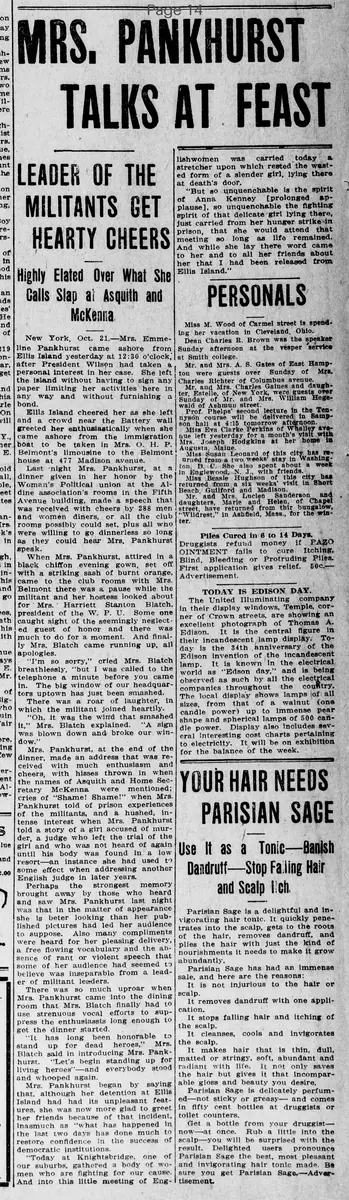
MRS. PANKHURST TALKS AT FEAST
LEADER OF THE MILITANTS GET HEARTY CHEERS
Highly Elated Over What She Calls Slap at Asquith and McKenna
New York, Oct. 21.—Mrs. Emmeline Pankhurst came ashore from Ellis Island yesterday at 12:30 o'clock, after President Wilson had taken a personal interest in her case. She left the island without having to sign any paper limiting her activities here in any way and without furnishing a bond.
Ellis Island cheered her as she left and a crowd near the Battery wall greeted her enthusiastically when she came ashore from the immigration boat to be taken in Mrs. O. H. P. Belmont's limousine to the Belmont house at 477 Madison avenue.
Last night Mrs. Pankhurst, at a dinner given in her honor by the Woman's Political union at the Aldine association's rooms in the Fifth Avenue building, made a speech that was received with cheers by 288 men and women diners, or all the club rooms possibly could seat, plus all who were willing to go dinnerless so long as they could hear Mrs. Pankhurst speak.
When Mrs. Pankhurst, attired in a black chiffon evening gown, set off with a striking sash of burnt orange, came to the club rooms with Mrs. Belmont there was a pause while the militant and her hostess looked about for Mrs. Harriett Stanton Blatch, president of the W. P. U. Some one caught sight of the seemingly neglected guest of honor and there was much to do for a moment. And finally Mrs. Blatch came running up, all apologies.
"I'm so sorry," cried Mrs. Blatch breathlessly. "but I was called to the telephone a minute before you came in. The big window of our headquarters uptown has just been smashed."
There was a roar of laughter, in which the militant joined heartily.
"Oh, it was the wind that smashed it," Mrs. Blatch explained. "A sign was blown down and broke our window."
Mrs. Pankhurst, at the end of the dinner, made an address that was received with much enthusiasm and cheers, with hisses thrown in when the names of Asquith and Home Secretary McKenna were mentioned; cries of "Shame! Shame!" when Mrs. Pankhurst told of prison experiences of the militants, and a hushed, intense interest when Mrs. Pankhurst told a story of a girl accused of murder, a judge who left the trial of the girl and who was not heard of again until his body was found in a low resort—an instance she had used to some effect when addressing another English judge in later years.
Perhaps the strongest memory brought away by those who heard and saw Mrs. Pankhurst last night was that in the matter of appearance she is better looking than her published pictures had led her audience to suppose. Also many compliments were heard for her pleasing delivery, a free flowing vocabulary and the absence of rant or violent speech that some of her audience had seemed to believe was inseparable from a leader of militants.
There was so much uproar when Mrs. Pankhurst came into the dining room that Mrs. Blatch finally had to use strenuous vocal efforts to suppress the enthusiasts long enough to get the dinner started.
"It has long been honorable to stand up for dead heroes," Mrs. Blatch said in introducing Mrs. Pankhurst. "Let's begin standing up for living heroes" and everybody stood and whooped again.
Mrs. Pankhurst began by saying that, although her detention at Ellis Island had had its unpleasant features, she was now more glad to greet her friends because of that incident, inasmuch as "what has happened in the last two days has done much to restore confidence in the success of democratic institutions."
"Today at Knightsbridge, one of our suburbs, gathered a body of women who are fighting for our cause. And into this little meeting of Englishwomen was carried today a stretcher upon which rested the wasted form of a slender girl, lying there at death's door.
"But so unquenchable is the spirit of Anna Kenney [prolonged applause], so unquenchable the fighting spirit of that delicate girl lying there, just carried from her hunger strike in prison, that she would attend that meeting so long as life remained.
And while she lay there word came to her and to all her friends about her that I had been released from Ellis Island."
What sub-type of article is it?
Biography
Historical Event
What themes does it cover?
Bravery Heroism
Justice
Triumph
What keywords are associated?
Suffrage
Militants
Pankhurst
Ellis Island
Dinner Speech
Anna Kenney
Hunger Strike
What entities or persons were involved?
Mrs. Emmeline Pankhurst
Mrs. O. H. P. Belmont
Mrs. Harriett Stanton Blatch
Anna Kenney
Where did it happen?
New York
Story Details
Key Persons
Mrs. Emmeline Pankhurst
Mrs. O. H. P. Belmont
Mrs. Harriett Stanton Blatch
Anna Kenney
Location
New York
Event Date
Oct. 21
Story Details
Mrs. Pankhurst arrives in New York after detention at Ellis Island, greeted by crowds, attends a dinner in her honor where she speaks enthusiastically about suffrage militants, shares stories of prison experiences and Anna Kenney's determination, receiving cheers and criticism of British officials.